
Watershed: a quick systems check for organisations
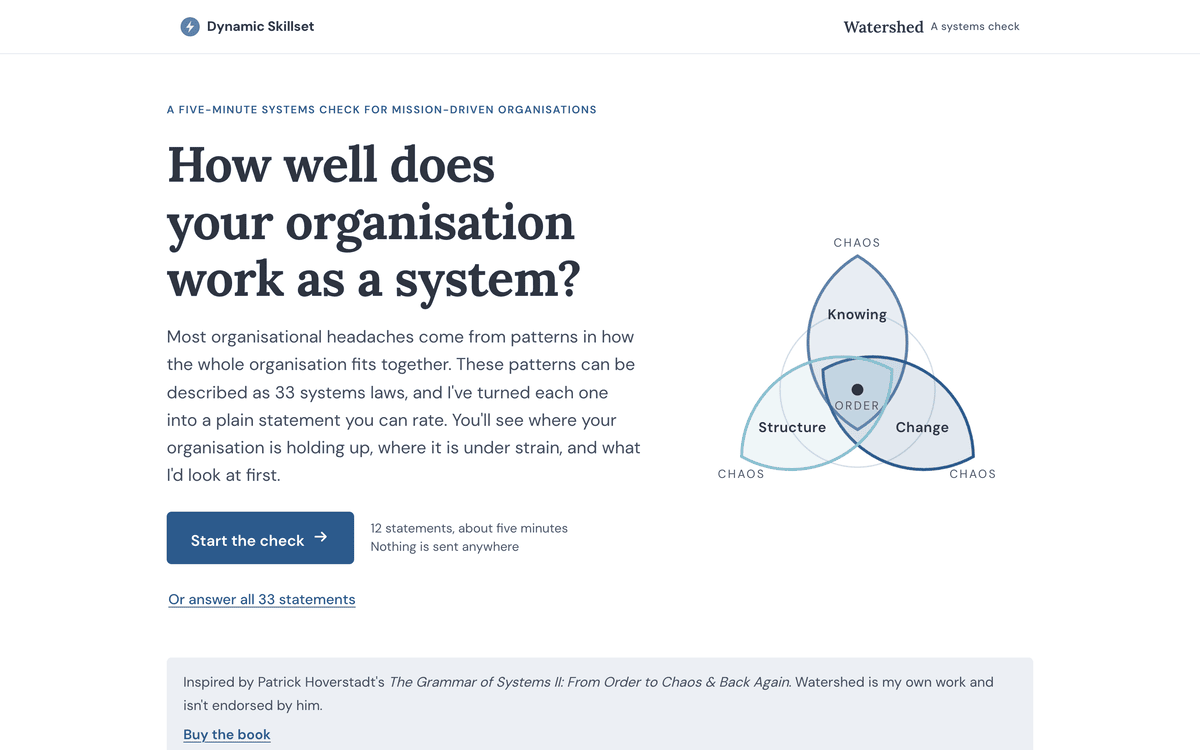
Most organisations don't work systemically. They deal with problems one part at a time, and then are surprised when they find the same issues returning time and again.
For mission-driven organisations such as charities, co-ops or public service institutions, it can be hard to picture what working systemically would even look like. Instead of a bunch of theory, people first need a quick sense of systems practice, in terms that make sense for their own organisation.
Watershed is my attempt to provide this, and of course it can only go a small way. What is it? A short, free self-assessment drawing on the systems laws and principles in Patrick Hoverstadt's The Grammar of Systems II. The laws describe how organisations behave and whether or not anyone is paying attention.

You start by choosing the part of your organisation to look at. This is known as the 'boundary' which might be your whole organisation, a leadership team, a service you provide, or your own team. If you like, you can say what it's part of and what it's there to do. Where you draw the boundary changes what you see, so it's important that this step comes first.
Next, you respond to a series of plain-English statements. The quick scan has 12 and the full check covers all 33 laws. I've grouped them into three areas:
- how the system copes with change
- how well it knows itself and its surroundings
- how it is structured
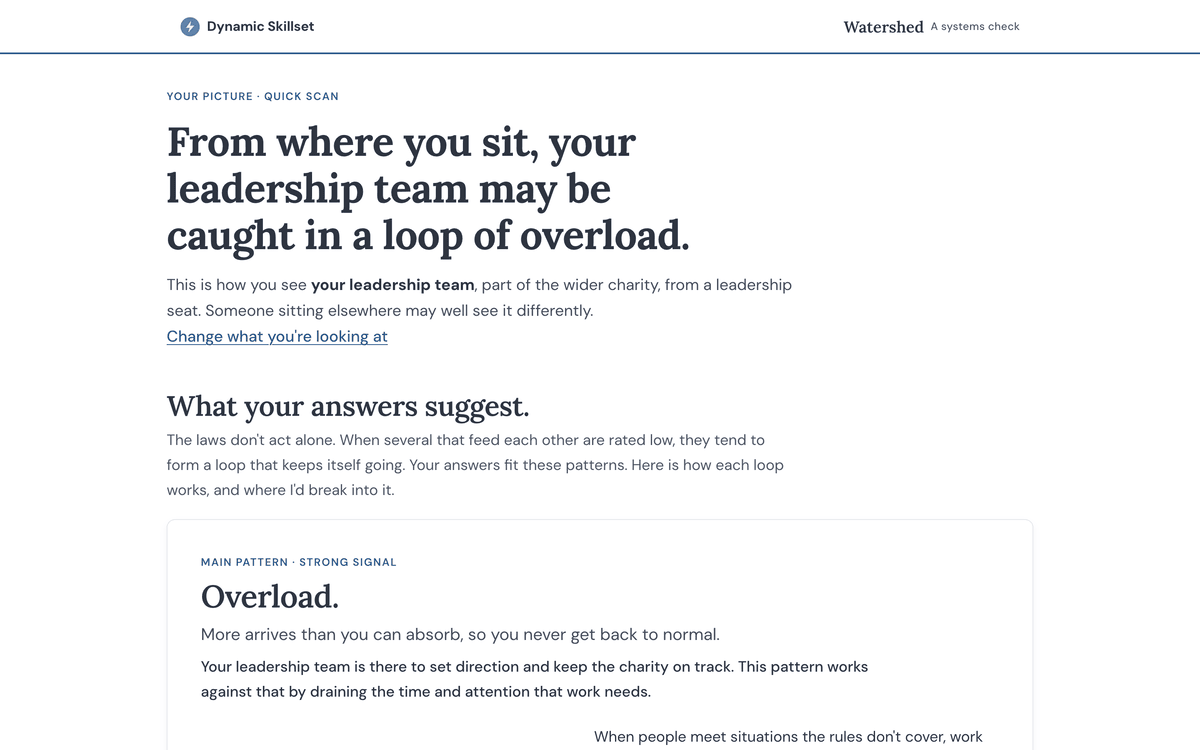
Your results show patterns including feedback loops such as overload, steering blind or snap-back, where one problem feeds another. Each of these patterns comes with signs to look out for and a place to start.
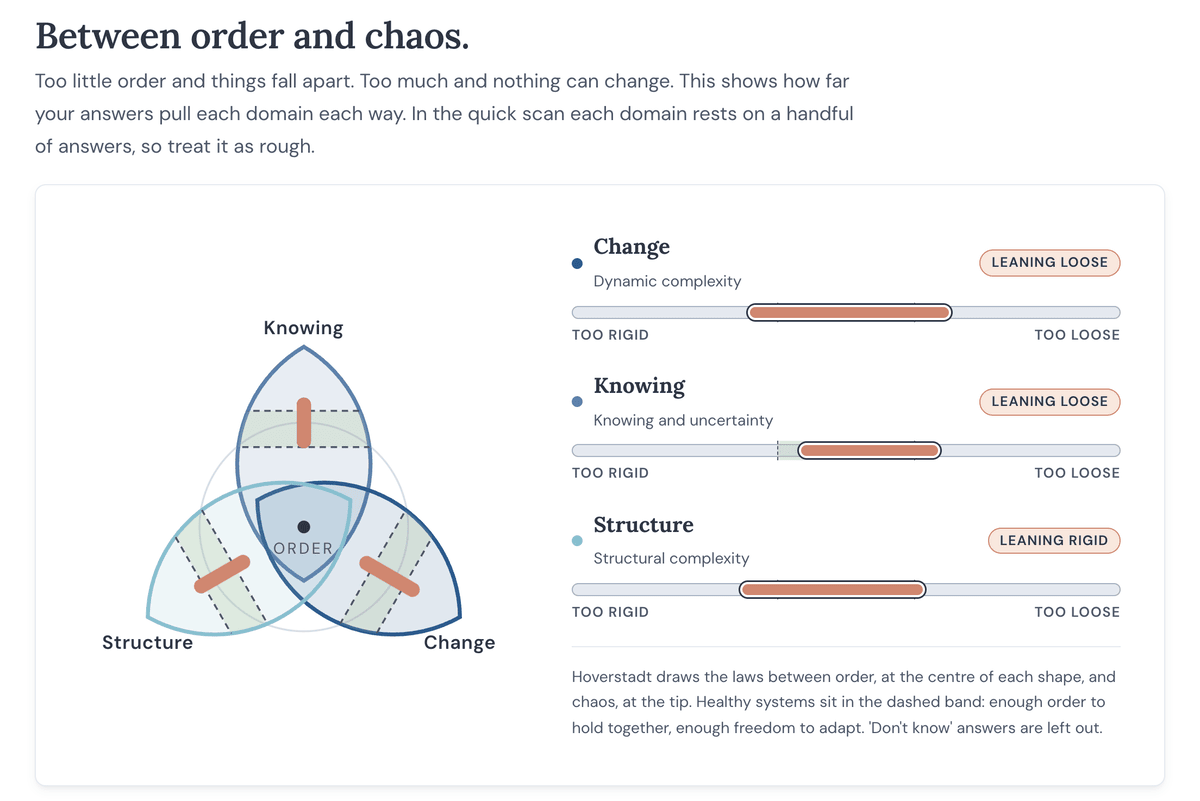
 For each area, Watershed shows whether it leans too far towards rigid order or loose chaos. Healthy systems need a bit of both.
Watershed is a diagnostic, and a very brief introduction to systems thinking and practice. It gives one person's view, formed in a few minutes, of an organisation that others will see differently. Working systemically takes much more effort and insight. It means people from across the organisation comparing how they see it, mapping how work and decisions really flow, reading and learning about systems thinking – and often getting help from someone who has done it before. Watershed can show you where to start looking.
Your answers stay in your browser and nothing is sent anywhere. The code is open source.
I drew on Patrick's work, but he hasn't endorsed Watershed and the simplified wording is mine. If you find the ideas useful, please buy his book. If you're not sure where to draw the boundary, try Sightlines, a companion tool I built for that job.
And if your results raise questions you'd like to talk through, book a call with me! 😀