
#SysPrac26 – Day 2
 After a great Day 1 I had high hopes for the second day of SCiO's annual conference. Although the opening panel session on Systems Thinking in Government inexplicably didn't get beyond introductions and positioning statements in the time allotted, the rest of the day was fantastic.
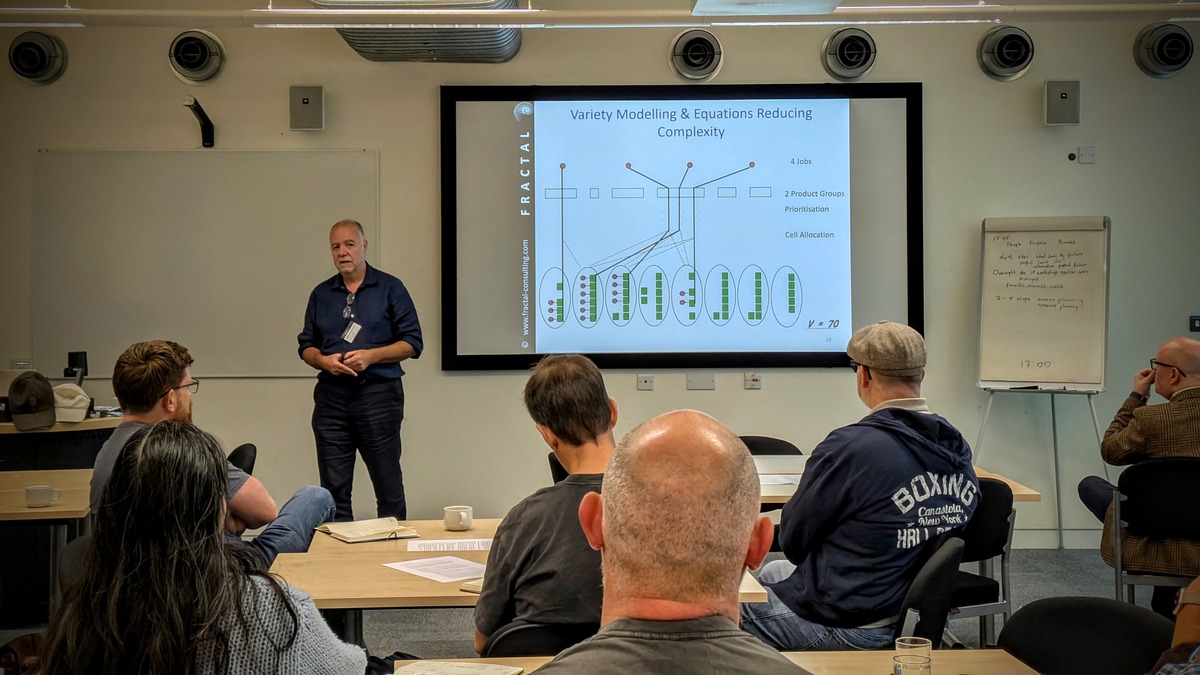
I attended two sessions before I needed to head off in order to be able to visit my sister in her new home in Nottingham, charge the car, and get back home at a reasonable hour. The first, run by Patrick Hoverstadt, was entitled VSM - Balancing Complexity and focused on the Viable System Model.
 What I really appreciated about this session was Patrick's reframing away from complicated diagrams and towards the five tensions that VSM is built around. The following is my attempted capture of what he said and, to be honest, I didn't quite get the difference between 4 and 5:
- Can we deliver?
- Can we balance needs?
- Can we reconcile autonomy and cohesion?
- How fast is the outside world changing?
- How fast can our system change relative to the outside world?
These five questions are, essentially, the five 'systems' of VSM and Patrick likened them to "a series of elastic bands knotted together" meaning that, in design mode, you're trying to help the organisation deal with the tensions.
As anyone familiar with VSM would expect, much of the session dealt with requisite variety and, indeed, the exercise given to each table involved calculating variety within an NHS case study. Patrick's mention of the "edge of chaos" being where an organisation hasn't got enough variety to deal with its environment certainly resonated with me and some of the organisations I've worked with (and within).
During lunch I continued an interesting conversation with James Marchant, who I'd sat next to in the previous session, and I also purchased two books:
- Opening the box: systems thinking for transformative conversations
- The Grammar of Systems II: From Order to Chaos & Back again (2nd ed)
The second of these led directly into the session I attended after lunch, which was organised at short notice given that one of the workshop facilitators couldn't make it. Gavin Roberts and Carla Owen guided us through 33 Systems Laws & Principles, organised into different kinds of complexity.
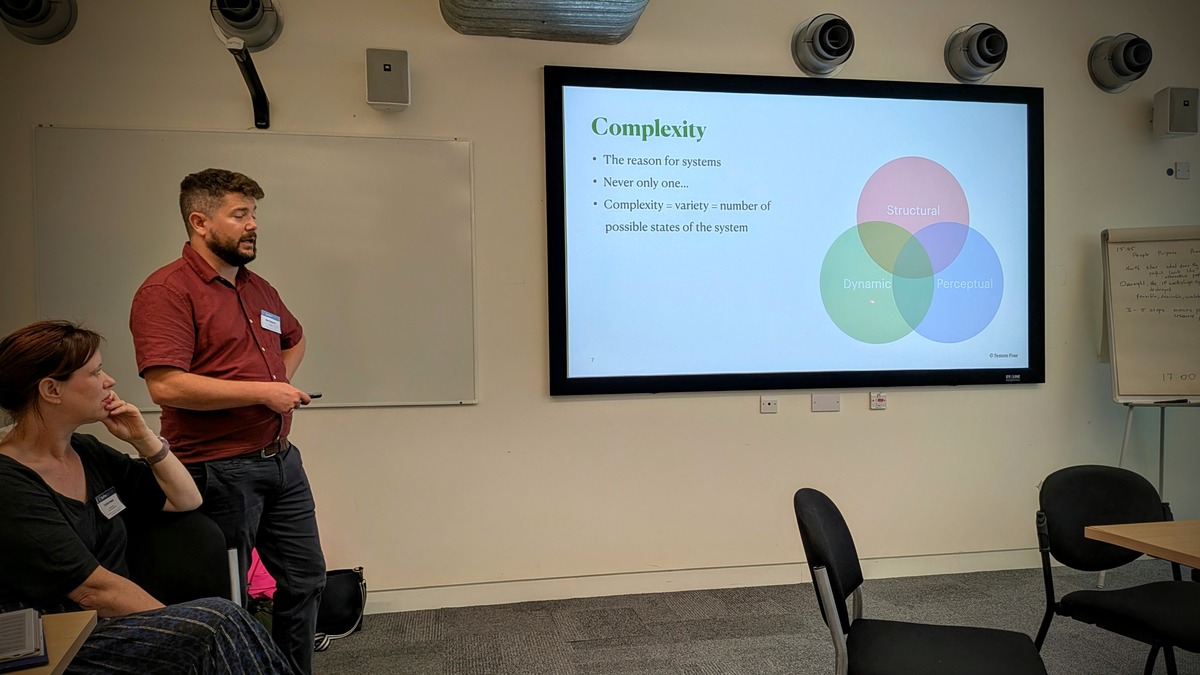 I asked my Little Robot Friend to OCR the sheets of paper we were given so that I can reproduce them below. This is mainly for my own benefit, as this seems to be how more advanced Systems Thinkers work: like chefs thinking in terms of ingredients rather than just in recipes, so they think in terms of systems laws and principles rather than just models.
Note: The quoted description is the "official" version and then I've provided a more straightforward explanation along with an example. The questions are from the session handout.
Systems Laws: Dynamic Complexity
First Circular Causality Principle
Given positive feedback, radically different end states are possible from the same initial conditions.
i.e. Small differences can grow into very different results when a system reinforces its own change.
e.g. A popular service attracts more users. More users make it more useful, which attracts still more users.
- Questions to consider: What positive feedback loops are there? What potential is there for growth? How can you enable it? What can “run away”?
Order Osmosis Principle
Systems elements flow across porous boundaries from less organised to more organised systems.
i.e. People, resources, and information tend to move towards systems that appear more organised and better able to use them.
e.g. Staff may move from a poorly run team to one with clearer roles and better tools.
- Questions to consider: Where is the “pull” or “push” for system elements? Where are they “pooling”? How porous is the boundary?
Relaxation Time Principle
System stability is possible only if the system’s relaxation time is shorter than the mean time between disturbances.
i.e. A system stays stable only if it can recover from disruption before the next disruption arrives.
e.g. A support team can cope with occasional outages. It will struggle if new incidents arrive before the previous ones are resolved.
- Questions to consider: What are the shocks, their effects and frequency? What “relaxes” the system — and how quickly?
System Survival Theorem
To survive, the rate of change of the system must be equal to the rate of change in the environment through time.
i.e. A system must change at roughly the same speed as its environment if it is to survive.
e.g. A training provider must alter its offer as employers, learners, funding rules, and technology change.
- Questions to consider: How quickly does/can the organisation change? How does it change? How quickly is the environment changing?
Second Circular Causality Principle
Given negative feedback, the equilibrium state is invariant over a wide range of initial conditions.
i.e. Balancing feedback brings a system back towards a stable state, even if it starts from different positions.
e.g. A thermostat turns heating down as a room warms up. It helps the room return to its set temperature.
- Questions to consider: What is balancing what? Is this balancing or constraining — and what’s desirable? How can you stabilise, or remove stabilisation?
Systems Laws: Perceptual Complexity
Law of Calling
Systems are defined by setting their boundaries.
i.e. A system depends on where you draw its boundary. Changing the boundary changes what counts as part of the system.
e.g. A school can mean its staff and pupils. It can also include families, governors, suppliers, local services, and government policy.
- Questions to consider: What’s “in”; what’s “out”? How does drawing a different boundary affect this?
Conant Ashby Theorem
Every good regulator of a system must be a model of that system.
i.e. A system can only be controlled well by someone or something that has a useful model of how it works.
e.g. A timetable tool needs a good picture of rooms, staff availability, learner needs, and course requirements.
- Questions to consider: What is the model in use? How correct (or useful) is the model? Does it predict the outcome of changes?
System Resonance Principle
Stimulus for a system occurs when its shape matches the system’s feature-filters.
i.e. A system responds to messages or events that match what it is set up to notice. It may ignore the rest.
e.g. A funding programme will notice proposals that match its criteria. Good ideas outside those criteria may receive no response.
- Questions to consider: Which systems resonate? What triggers them? How does the “feature filter” exclude or include demand?
Law of Conservation
Whenever a system boundary is crossed there is a state change.
i.e. Crossing a system boundary changes something.
e.g. When a person joins an organisation, they gain access, duties, rights, and relationships. The organisation changes too.
- Questions to consider: What boundaries are crossed (or not)? What changes happen? What are the implications?
Darkness Principle
No system can be known completely.
i.e. No one can know a system fully. There will always be gaps, uncertainty, and effects that cannot be predicted.
e.g. You can research how a policy may affect staff, but you cannot know every response before the policy takes effect.
- Questions to consider: Do you know enough? How can you know more? What is unknowable — and how will you deal with that?
Systems Laws: Structural Complexity
Complexity Instability Principle
Systems with too many active, inter-dependent elements are incipiently unstable.
i.e. A system becomes less stable when it has too many active parts that depend heavily on each other.
e.g. A service that relies on many connected suppliers, spreadsheets, approvals, and manual handovers is easier to disrupt.
- Questions to consider: What’s active, and interacting? What’s overly dependent on what? How can this be reduced?
Law of Reciprocity of Connections
If A connects to B, B also connects to A — directly or indirectly.
i.e. If one part of a system affects another, the effect runs both ways, directly or through other parts.
e.g. A change to a website’s registration process affects users, support staff, data systems, reporting, and future service decisions.
- Questions to consider: What’s connected? What’s not? What hidden connections are there? How can you sever, or leverage them?
Viability Principle
Viability is a function of the balance maintained along two dimensions:
- Stability versus adaptation of the system as a whole
- Stability versus adaptation of the parts
i.e. A viable system must balance consistency with change. The whole system and its parts both need room to adapt.
e.g. A university needs shared rules and standards, but departments need enough freedom to respond to their subjects and students.
- Questions to consider: Does the system exhibit stability or adaptation? Is it centralised or decentralised? What are the limits to this, given its environment? What needs to change — and how?
Law of Requisite Variety
Only variety can absorb variety.
i.e. A system needs enough possible responses to deal with the range of situations it faces.
e.g. A helpdesk facing technical, financial, safeguarding, and access issues needs more than one standard response.
- Questions to consider: What variety is presented (count)? What does the system do about it? Is it requisite? If so, improve it! If not, how rectify?
Bonus: Fractal Principle
Systems which create systems will produce structures that are copies of their own structure.
i.e. Systems often reproduce their own structure when they create new systems.
e.g. A highly centralised organisation may set up projects and teams that are highly centralised too.selected_image_9199280301700657010.jpg+2
- Questions to consider: Where do you see this? Implications?
All in all, I had a great time and the work of SCiO is to be applauded, especially as a non-profit, volunteer organisation. I intend to get more involved!