
Introducing RACK: tell your AI tools how you work
 We've published another essay over at FIELD STATION entitled Governance Is Not a Dashboard. This post is a TL;DR of it, explaining how applying the Viable System Model (VSM) is even more achievable in a world of AI agents.
VSM describes any organisation as five interacting parts.
- System 1 does the actual work: the caseworkers, the classroom, the shop floor.
- System 2 stops those units colliding with each other.
- System 3 holds operations coherent, here and now.
- System 4 looks outward, watching for what's about to matter.
- System 5 holds the question of what the organisation is actually for.
Each part has always run into the same wall. System 1 can only absorb as much complexity as its people and processes allow, so organisations write procedures and shrink what counts as "normal" until the work fits. System 3 has never had the visibility to coordinate more than a handful of units without hiring expensive middle managers to do it by hand, and when it takes on too much of that job directly, the model has a name for the result: hypertrophy of System 3, where the coordinating function swells to cover work that belongs with the units themselves.
System 4 gets cut first when budgets tighten, because scanning the horizon produces nothing you can point to next quarter, and a System 4 that goes missing entirely gets called, in the same taxonomy, a headless chicken: a system with no way of sensing what's coming. System 5 ends up as a handful of people making calls on everyone's behalf, not because the model asks for that, but because it was the only way most organisations found to keep decisions moving at all.
Traditionally, the issue is that the VSM is not only complex, but recursive. Ideally, all five systems operate at each level of the organisation, nesting inside one another.
A model nobody can hold in their head gets replaced by whatever fits in a dashboard, and a dashboard is, structurally, a command-and-control instrument. People don't set out to strip Beer's work down to its worst version. They reach for the simplified one because the real one was never made legible, and the simplified version happens to concentrate power at the top.
AI agents mean that can change:
A caseworker whose AI tool can draft, summarise, and cross-reference in seconds can handle more of their own casework's variety without escalating every unusual case upward. That's more capacity sitting at System 1, not less. A coordination function that used to need a room full of people tracking dependencies can now do it with two people and a model, in something closer to real time: System 2's job, done properly, in organisations that could never previously afford to do it at all. Environmental scanning, always the first line item cut, gets cheap enough to sustain without a research department.
The trouble is that it's extremely tempting to conceptualise VSM as something which centralises control within an extreme hierarchy. We don't believe that this needs to be the case.
The easier move, and the one organisations keep reaching for, is the same one the diagram already nudges them towards: point the new capability upward instead of outward. Feed the model's output into one dashboard, hand System 5 the summary, and turn System 3, without anyone announcing it, from "coordinating autonomous units" into "watching them".
We've seen this pattern often enough with clients to name it without flinching: it rarely starts as anything sinister. Someone asks whether the AI tool can flag when people drift from the guidelines. A couple of meetings later, flag has become mandatory, and mandatory has become a report on who didn't comply.
Instead, we want to encourage people to use the VSM to enable coordination without surveillance. Hence us building RACK.
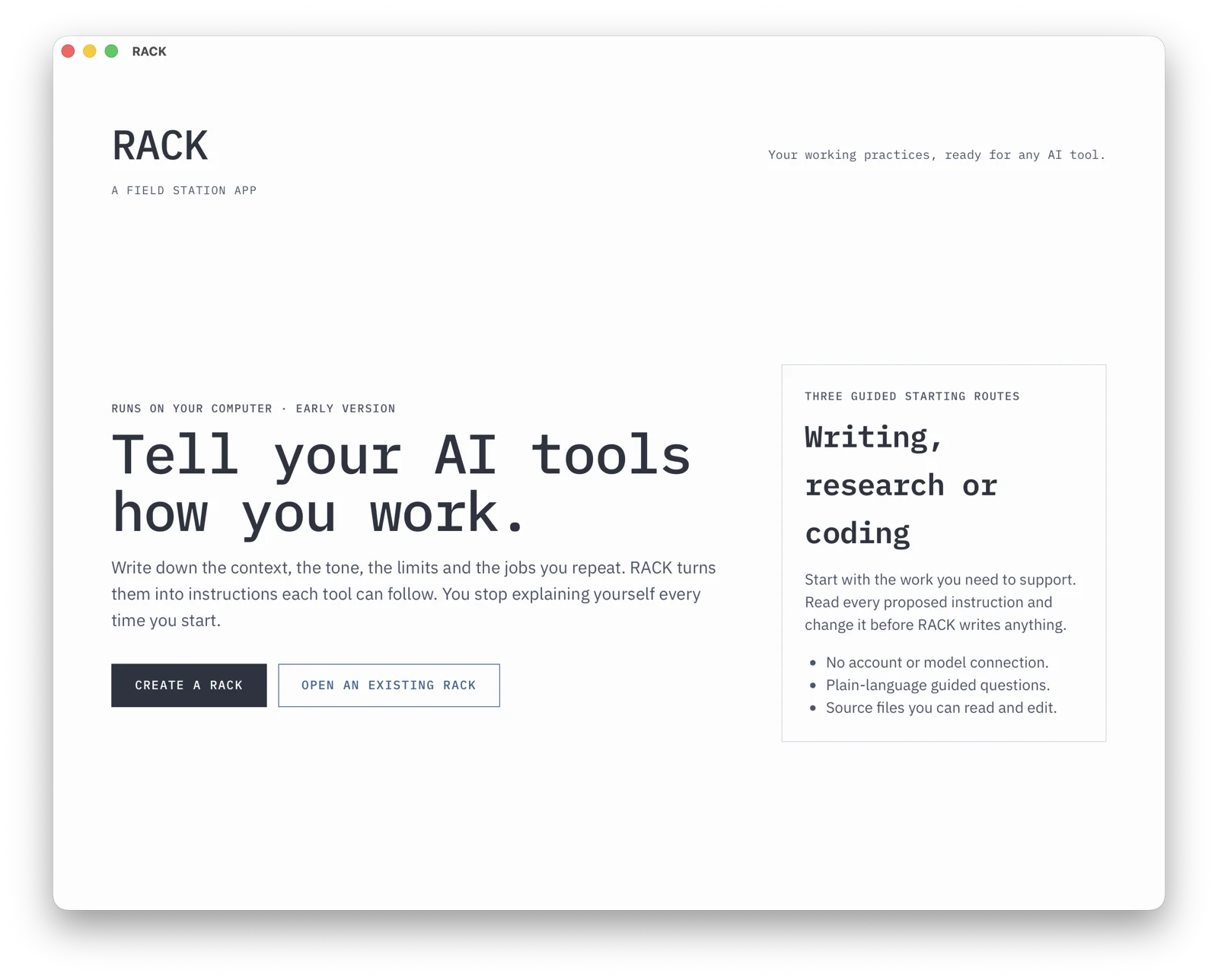
RACK, in active development, exists because... a shared practice, like a shared model, only holds up if the people using it can actually see what it's doing. The idea is to let a person or a team write down how they work, once, and turn that into instructions their AI tools actually follow.
What matters more than the mechanism is what it refuses to do, and why: a required instruction has to come with a written reason and can't be overridden downstream, because System 2 coordination only works if everyone can see where a rule came from. A default is a shared convention, adaptable by whoever is nearest the work, no permission needed, because the person doing the work is still better positioned to judge it than anyone watching from above. A personal instruction never leaves that person's machine.
If a shared rule overrides someone's own instruction, RACK says so immediately rather than letting them discover it later in the output. If someone adapts a shared default for themselves, that adaptation is never transmitted, logged, or reported upward. There's no dashboard showing a manager who changed their own defaults, and building one would defeat the entire point of the tool.
That's the difference between a System 2 that helps units coordinate and a System 2 that watches them.
There's a TechFreedom angle here as well.
There's a sovereignty question sitting underneath this too. Renting organisational judgement from a handful of large AI vendors, most of them sitting in jurisdictions with their own regulatory agendas, just recreates the top-down problem at a different layer of the stack. An organisation can decentralise its own decision-making and still hand the underlying capability to somebody else entirely.
We made this case at length in The Sovereignty Stack Has No Bottom: sovereignty isn't a destination, it's a ratio, and every layer where it gets declared solved conceals another layer where it wasn't. The same ratio applies here.
There are links to Mac and Linux versions of RACK over at the code repository. Please do try it out!