Consequences have boundaries
I’ve just realised that yesterday’s post about consequentialism is closely related to something I studied as part of my postgraduate Systems Thinking qualification: Critical Systems Heuristics, or CSH. The 2x2 grid I shared in that post was a way of resisting the lazy claim that a system is justified merely because it “works”. CSH provides a more disciplined way to ask what is hidden behind that claim.
CSH starts the proposition that every account of a system draws boundaries. In other words, someone decides what the system is for, who counts as a "beneficiary," what counts as success, whose knowledge is credible, who has authority, and whose interests can be treated as outside the decision. These are moral and political judgements.
The 12 CSH questions are grouped under four sources of influence: motivation, control, knowledge, and legitimacy. They ask about the people involved in a system, along with those affected by it but excluded from its decisions.
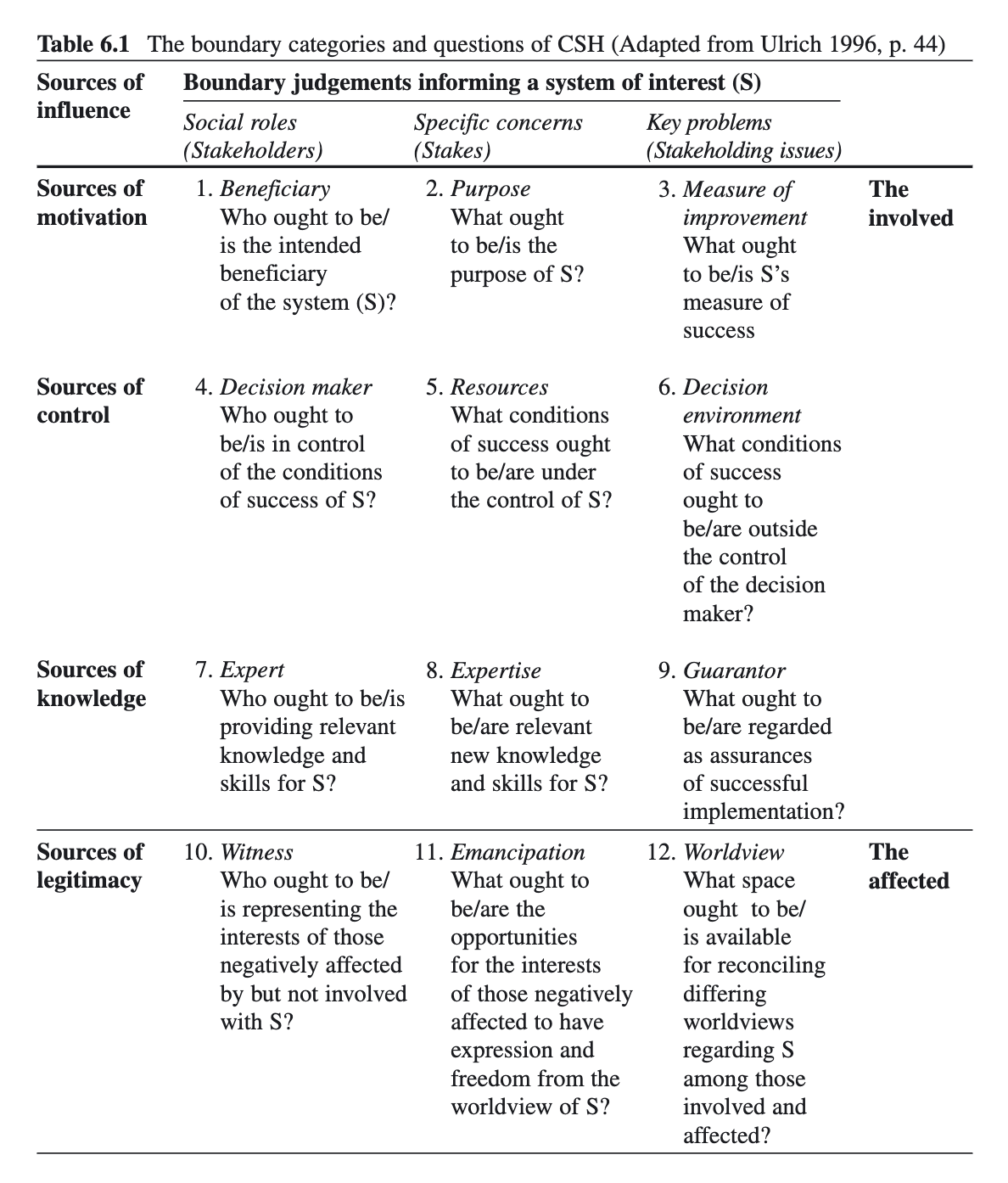
In terms of linking this to yesterday's 2x2 grid:
- Questions about direct harm and benefit draw attention to beneficiaries and measures of improvement
- Questions about duty and responsibility concern decision-makers, resources, and conditions of control
- Questions about governance ask who has authority, whose expertise is recognised, and who can challenge a decision
- Questions about systemic consequences lead towards CSH’s questions about witness, emancipation, and worldview: whose interests are not represented, what possibilities are closed off, and which way of seeing the world is being built into the system?
CSH asks each question twice, first: how is the system is currently arranged? And then second: how ought it to be arranged? Identifying that gap is important as it stops critique simply being a "vague objection" to technology or institutions, instead turning it into a practical comparison between the present system and a more ethically defensible one.
Let's take an example. Yesterday, I discussed the university using genAI to speed up student feedback. The current account may say that students are the beneficiaries, faster turnaround is the purpose, senior leaders and procurement teams are the decision-makers, and data about turnaround time demonstrates "success".
A second pass asks different questions. Which students ought to benefit? Is speed really the purpose? Who ought to have control over the conditions of feedback? Whose educational expertise should count? Who speaks for students whose need for recognition, dialogue, or accessible support is not represented in the metrics being used?
This is useful because it's more than a dispute over whether genAI is "good" or "bad". Instead, it's a dispute over the boundary of the system: what counts as feedback, which outcomes count as success, who gets to decide, and whose losses are "acceptable".
I think the 2x2 grid is setill useful as a quick orientation, but CSH offers a way to follow-up by querying the institutional assumptions that organise decision-making. So if someone says a system “works”, the next question is not only “for whom?” it's: “Who was able to define what working meant?”
Enjoyed this? Get new notes by email
A digest of new notes, daily, weekly or monthly. Confirm by email, unsubscribe any time. Prefer a feed reader? Subscribe via RSS.
Around this note
Grows from
Feeds into
Shares soil with
Suggested by AI from similar content