
Being complicit in creating the conditions we say we don’t want
After reading this, I realised that the way I organise my life is a bit like this. Really, it's about boundary-setting with yourself and others.
Sometimes it's about taking things away and setting limits; other times it's about adding something as a different option - for example, my analogue desk gives me a different thing to do in the morning rather than immediately go on a screen.
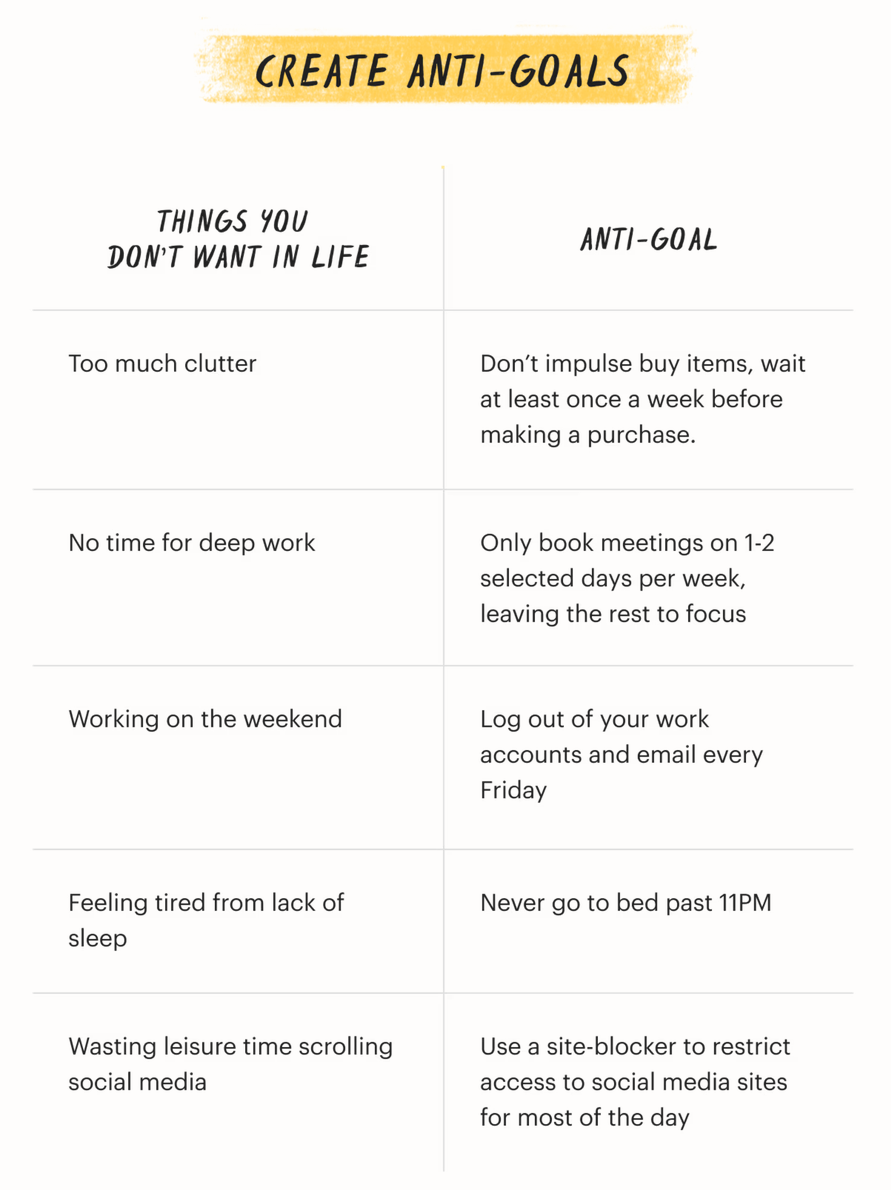 > A few years ago Andrew Wilkinson, the Co-Founder of Tiny, was unhappy: work was getting in the way of the life he wanted to live. His calendar was packed with meetings, he was doing business with people he didn’t like, and he was stressed with the demands on his schedule. In an attempt to regain control and make work feel less like work, he took a novel approach to turning things around: anti-goals.
Wilkinson imagined his worst possible day –– meetings, travel, fatigue –– and worked backwards to set anti-goals, rules for avoiding this worst case scenario. For instance, in response to his desire to leave behind a day “full of long meetings”, he set the following anti-goal: “Never schedule an in-person meeting when it can otherwise be accomplished via email or phone (or not at all)”.
This goal setting method is a powerful alternative to regular goal-setting because you need to tie an anti-goal to an undesirable aspect of your life. In setting an anti-goal, it’s helpful to ask yourself this question from Jerry Colonna, a Coach and CEO of Reboot: “How am I complicit in creating the conditions I say I don’t want?”
Harness the power of anti-goals and create your own with these three steps:
Draw a vertical line down the middle of a blank piece of paper
On the left hand side, list 3-10 things you’re unhappy with in work or life that you would like to avoid or eliminate.
For each condition of the left, create an anti-goal on the opposite right hand side with a tangible solution for solving this problem.
Anti-goals give us the opportunity to reflect on the life we don’t want in order to forge the one we do.
Source: todoist