
Creativity is just connecting things
 I first came across Are.na in early 2018 when I was doing my research for the whitepaper of what became MoodleNet. It's a wonderful place, and one that I've spent much more time over the last year or so as a Premium subscriber.
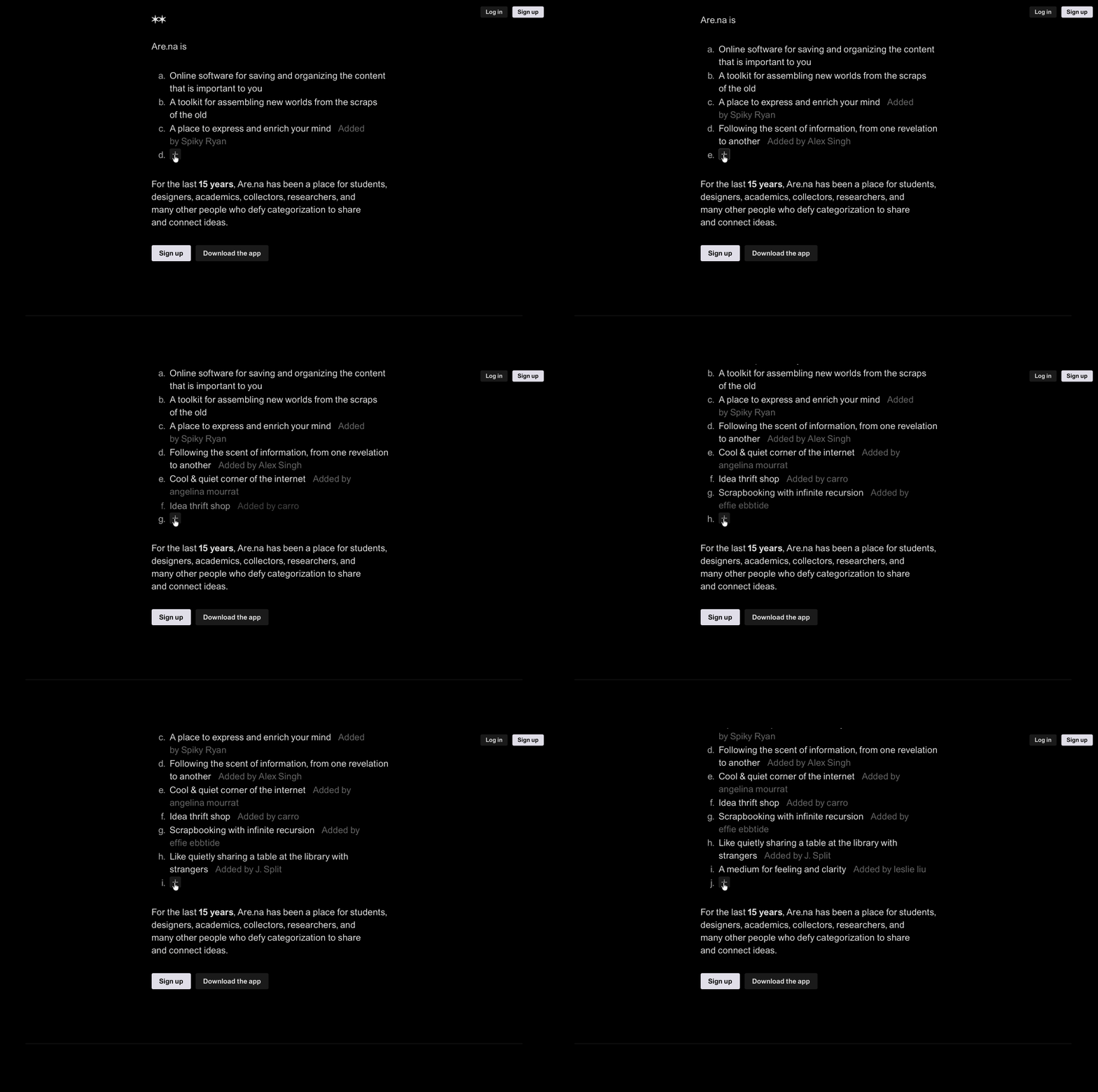
The site is 15 years old today, and I love some of the copy they've included on the newly-redesigned logged-out home page:
No ads, no personalized recommendations
On Are.na, there's nothing algorithmic steering you into any particular direction.
The content you are exposed to is only based on a network you've intentionally cultivated for yourself, guided by your own internal radar.
The result is a kind of texture of a network that is both difficult to replicate and rewarding to traverse.
[...]
The secret
Allow yourself to go down rabbit holes
A rabbit hole is not a distraction. A rabbit hole is your brain trying to tell you to pay attention to something you’re curious about. Ignore algorithmic rabbit holes.
If you see something, save something
Pay attention to what feels resonant to you. Save breadcrumbs and build a path for yourself to walk down later on. The ability to classify information in a personal way is a muscle worth exercising.
“Creativity is just connecting things”
Over time, build contexts for yourself and your ideas. Analyze what happens when you connect those contexts to someone else’s.
Remember
The goal is not self-improvement. The goal is engaging more deeply with the World.
There's also an essay that Charles Broskoski, one of the co-founders, published to celebrate the occasion which includes this section:
At first, we wanted a description that captured everything we thought was special about Are.na: the tool itself, the people who used it, and the quality of the content. That struggle was intensified because being able to describe it succinctly and accurately had a real world business outcome tied to it. In theory, the better we are at describing it to a person who is completely uninitiated, the more likely a person is to try it.
But over time, we started to realize the benefit to leaving Are.na a little bit opaque. There’s an aspect of illegibility that functions as a filter. There are some people who, intrigued by the challenge of figuring out a piece of software, push through towards understanding it, towards making it their own and toward building the habit of using it in the way that’s most useful and natural to them. Some others, who are used to websites or platforms that make every effort to remove friction, lose patience and leave. On some level, this is expected and acceptable.
Admittedly, there was also some internal reluctance to arrive at a perfect description of Are.na. We (the people that maintain Are.na) are all drawn towards software that is open-ended. We don’t want to be particularly hemmed in by a use case. We are comfortable with the potential that comes with ambiguity.
Anyway, the point is, somewhere along the way, it became easier to just let Are.na be what it is, without a strong definition to guide it.
In these days of algorithmic social networks it's an absolute haven. I love it.
Source: How do you describe Are.na at a party?
(There is, of course, an Are.na channel of the same name)