
Validation, recognition, and credentialing
So, I was "the reader" in question which prompted this post from my good friend Laura:
A reader pointed out that in my second assignment, I sort of waved off the question of “What does validation look like?” My protagonist was, to be fair, quite snarky in telling the professor what validation would look like. Thus, I am submitting this brief reflection for extra credit (or for full credit since I lost credit points by being dismissive of the question).
I've been sending her voice notes up to this point on the assignments she's set herself for her Not a Masters (NaM) but I've got a chat with her in 30 mins so this post is me getting my thoughts in order to give her useful feedback.
In the post, Laura is wrestling with the question what does validation look like? to which I would add what even is "validation"? Here's where she lands:
Validation is not an end state or a reward for a job well done. It is a signal to absorb and process something that has been achieved. The absorption is where the work gets real. It is the place we might hover, if we can figure out how to delay or outright stop setting new, higher bars for ourselves.
For me, that sparked some ideas around recognition and credentialing that, actually, Laura and I have worked on together over the years. Five years ago, I created this diagram to help explain the evolution of the wider credentialing ecosystem:
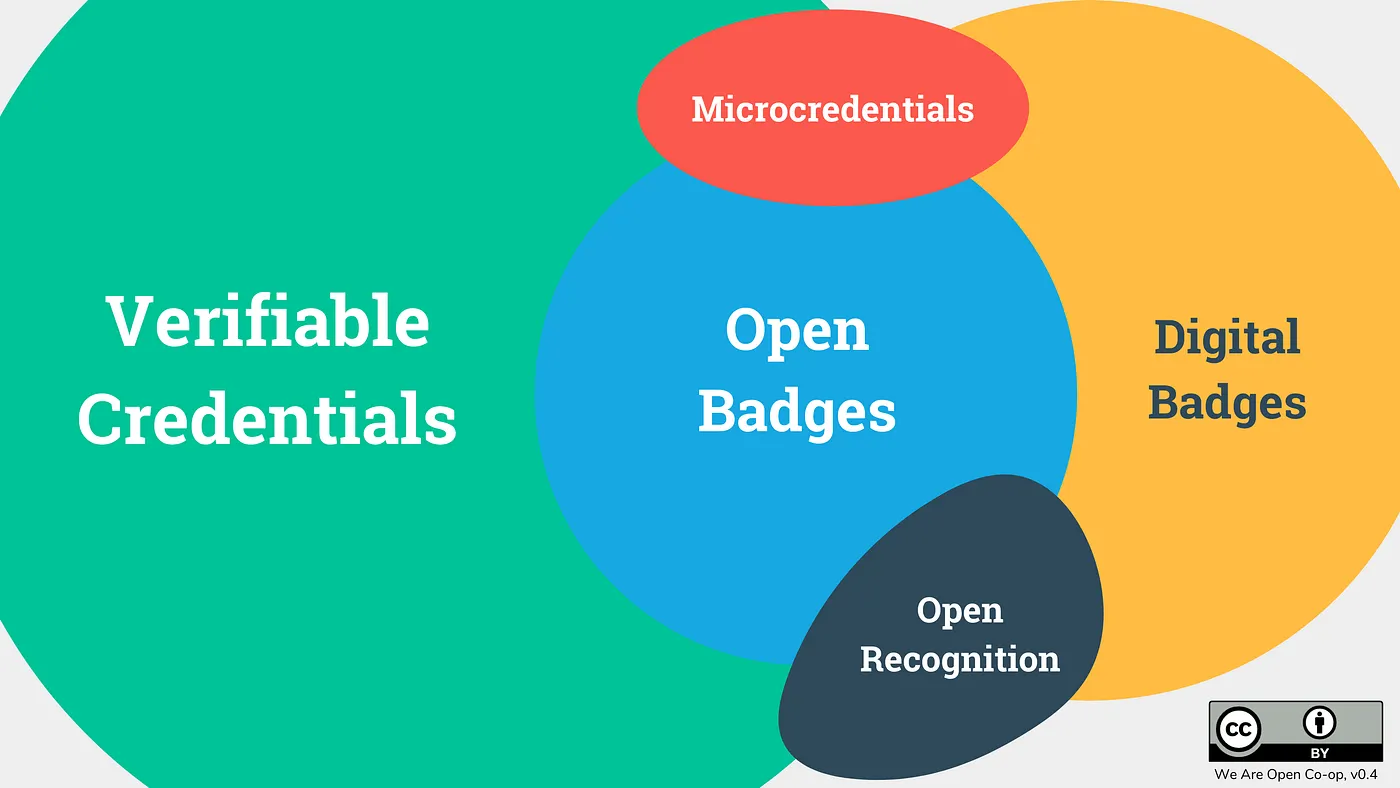 I had a chat with Serge Ravet from the Open Recognition Alliance last week, who reminded me about this diagram and how, really, Open Recognition doesn't fit well on there. Instead, Open Recognition is a separate concept to credentialing. Badges are an example of how recognition can be tokenised; recognition can happen outside of credentialing.
In the context of Laura's post, I think this is interesting, because (for me at least) it bring up the relationship between validation and recognition. The two are related, but how? Some thoughts, especially as I've just had a conversation with Tom Broughton about inter-personal and intra-personal dynamics:
- Validation is the intra-personal (i.e. "self-reflective") act of absorbing evidence that something happened or mattered – regardless of whether anyone else witnessed it
- Recognition can be thought of as the the inter-personal (i.e. "social") act of acknowledging that validation to another person (which might mean granting it visibility and/or shared meaning)
- Credentialing is therefore a formalised, portable way of encoding recognition (e.g. a badge or certificate) that makes that acknowledgement portable so that it travel across time and different contexts
In a perfect world, there is no "loss" in translation between these. So everyone feels validated, recognised, and credentialed.
But, of course, that is not the case. Hence Laura's post (and me getting involved in Open Badges 15 years ago!) What actually happens is:
- People struggle with internal validation without abundant external recognition
- Recognition can be given without being received, meaning that there's a signal loss between recognition being transmitted and absorbed
- An ever-increasing pile of credentials can accumulate as "proof" without producing the desired impact on self-worth (or, indeed, "closure")
At this point, we need another diagram:
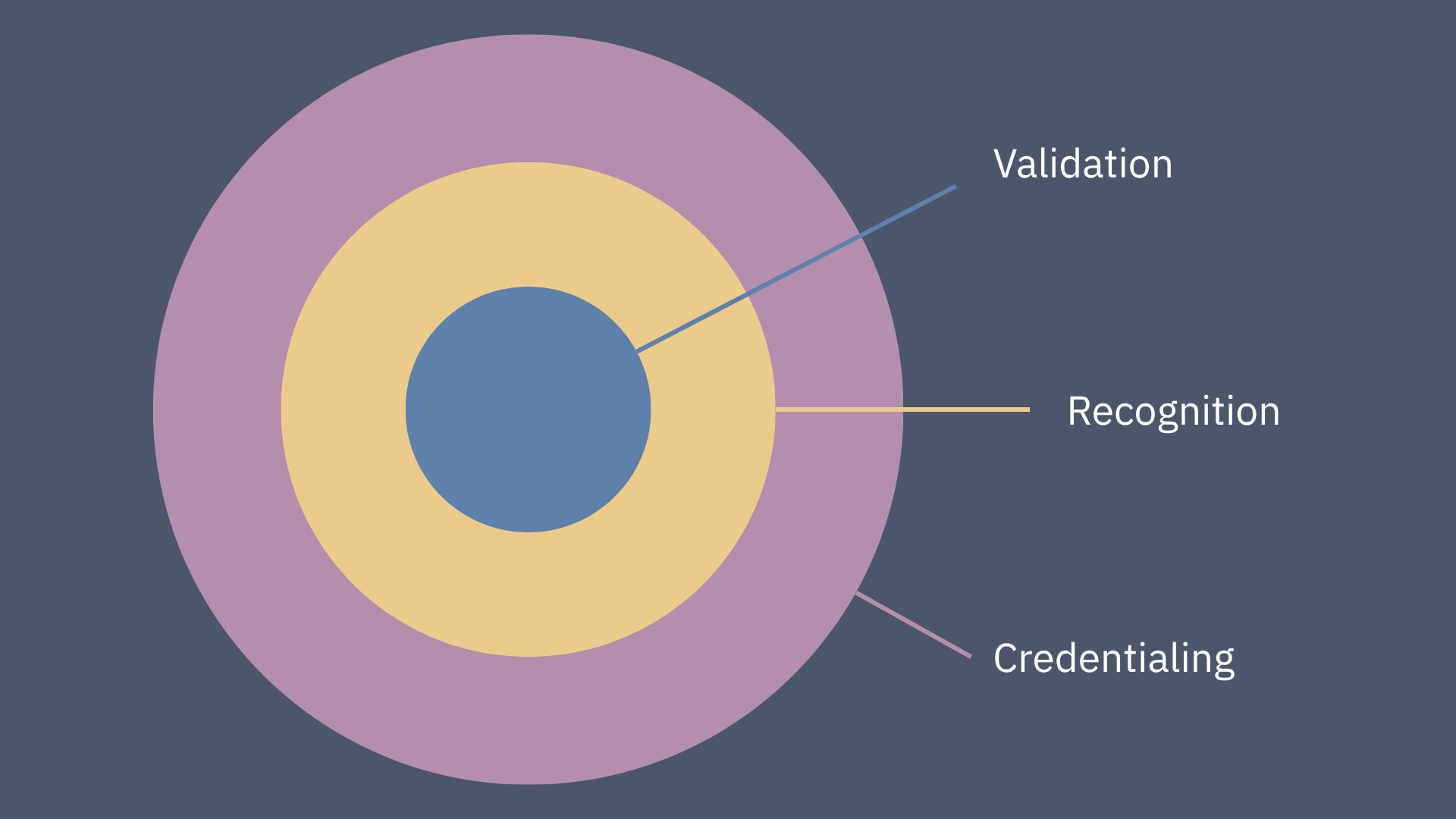 So what Laura's post and self-reflection has made me realise is that recognition systems shouldn't only be judged not only on verifiability and portability but on whether they create conditions for "absorption". This allows the validation to happen.
What does that look like in practice? Reflection prompts, providing narrative context, or qualitative feedback from peers/community members. That better than just a credential saying whether you've passed or failed.
Also, as I've known intuitively all my life, if we just reproduce gatekeeping structures in credentialing pathways, then we just reproduce the existing system. Nothing changes and it becomes like nuclear proliferation. "Oh yeah, you've got a Bachelors? Well I've got a Masters and all these badges..."
Third, and finally, I've realised that validation looks different for different people because we all have our own backstory, narrative history, and (dare I say it) trauma. So the way that validation gets absorbed is different, meaning that recognition needs to happen on many different planes.
Still lots to think about here 🤔
Reread this and was thinking I might push back / tweak / think about more: the internal vs external, intra versus inter distinction in validation and recognition. I feel like all of this process can and maybe should happen within a person, no social aspect. I'm interested in why and if we really need external validation or external recognition? Is there a level of mental health (a zen monk perhaps?) that can self-supply? Can we get high on our own validation supply?
Interesting! Although we talk about "self-validation" in the spirit in which we're discussing it here, my opinion would be that I don't think it can (or should) happen purely internally.
Even the zen monk sitting by themselves on top of the mountain has trained to get to that point, receiving feedback that keeps them going. The validation and recognition might mean that, eventually, we don't need it. But along the way, and while we learning? I think we definitely do!