Curriculum as algorithm. Curriculum as heuristic.
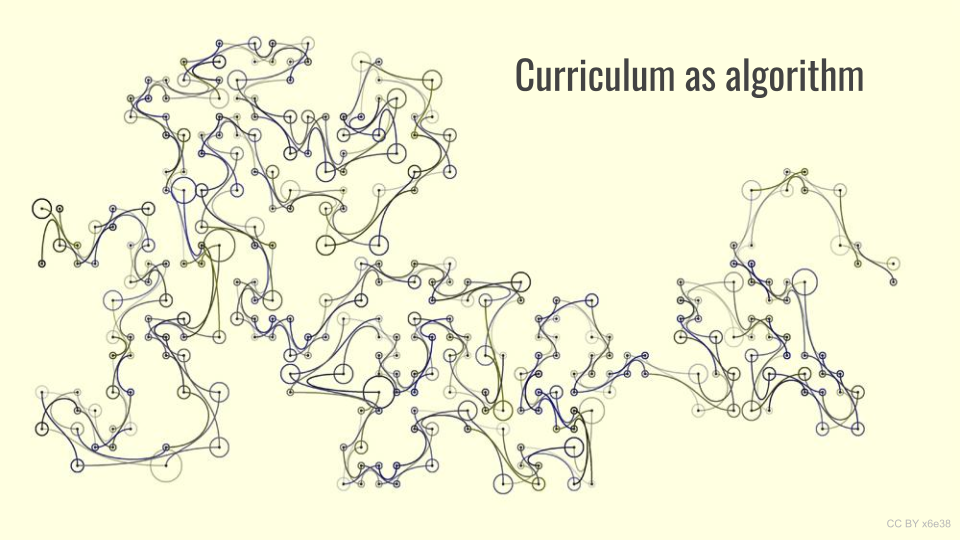
If you've ever seen me present on digital literacies or digital credentials, you've probably seen me use the above slide in passing. I use it to explain that every curriculum can be an algorithm. What I've never really taken the time to explain is that the other way of conceptualising a curriculum is as an heuristic.
Let's define terms before going any further, starting with algorithm:
a set of mathematical instructions or rules that, especially if given to a computer, will help to calculate an answer to a problem
That is opposed to an heuristic:
arriving at a solution by trying different actions to see if they produce the result that is wanted, rather than using strict rules
The former approach is digital, the latter analogue. Applied to education and learning, the former sees teaching as a science and the latter sees teaching as an art.
It's been a while since I was in the classroom, but I think it's fair to say that teaching is both an art and a science. It is both Robin Williams in Dead Poets Society and the structure of something like the National Literacy Strategy.
But where does one stop and the other start? 🤔
This post was prompted by me seeing Nick Dennis' response to Oak National Academy's draft knowledge graph of the national curriculum for England. Covering 13 subjects from Key Stage 1 through Key Stage 4, every subject, strand, unit, and lesson has its own permanent identifier. It's also built on W3C standards so that machines can read it. In other words, someone has built my slide.
What I find interesting is how careful Oak are about the limits of what they've made. They keep the statutory curriculum separate from their own sequence of units and lessons:
The national curriculum mostly sets out what pupils should learn and should be taught, not the order to teach it in. So our sequences reflect pedagogical choices, and how much those choices matter varies by subject. They’re one evidence-informed route, not the only valid one, and we keep them in a separate layer so you can build on the statutory structure without adopting our sequence. In maths, some dependencies are close to fixed: pupils need to understand fractions before they can divide them. In History or English, prior knowledge still matters, but there’s often greater scope for professional judgement about the order in which content is taught.
I used to be a History teacher, so that last sentence is important. Judgement matters when you're not teaching mathematical or scientific subjects.
The line between algorithm and heuristic doesn't fall between one kind of curriculum and another. It's a line that runs through every curriculum, but in a different place for each subject. Maths leans towards an algorithmic approach, whereas humanities subjects like History and English lean towards the heuristic. Before Maths teacher friends complain, yes even in maths, someone still has to notice that a particular pupil in a particular room hasn't understood fractions yet.
Nick responded to Oak's work with a post on the social construction of curriculum. He quite astutely uses Stuart Hall's encoding/decoding model to show that a curriculum never arrives in the classroom exactly as it was sent (or intended). As you'd expect, teachers read it, question it, and modify it for the pupils in front of them. While Nick accepts that Oak's work has advantages, his worry is what he calls "an ontology without an examined epistemology" – i.e. a knowledge graph that makes human choices about what matters look like a neutral structure. If we forget that, he says, "the teacher risks becoming the human face for judgements made elsewhere."
I agree that this is the risk of treating the whole curriculum as an algorithm and that ontologies are best left implicit. Otherwise, it means that the heuristic part, the decoding, gets squeezed out. But let's not kid ourselves that every teacher has the degree of autonomy that Nick imagines in his post. We're living in a world where, in the state sector at least, budgets are extremely tight.
As a pragmatist, I'd argue that we need both the algorithm and the heuristic. What I like about Oak's approach, at least if we take them at their word, is that they've built something that enables other products to exist:
The knowledge graph isn’t a product in itself; it’s what makes other products possible. Combine it with retrieval-augmented generation (RAG), where an AI system looks up information from an authoritative source before it answers, and an AI tutor can check verified curriculum structure instead of guessing. The language model provides the language; the knowledge graph provides verified domain knowledge and structure.
What I don't like about that particular phrasing is the mention of "guessing". The definition of an heuristic at the top of this page is from Cambridge Dictionary, which also gives another: "(of a method of teaching) allowing students to learn by discovering things themselves and learning from their own experiences rather than by telling them things". Good teachers guess all the time: about what a pupil already knows, why they're stuck, and what might work next. The algorithm can tell you where a lesson sits in a sequence, but it can't make those heuristic-based guesses for the teacher.
I'm not against what Oak have built and see it in the same domain as Khan Academy's Knowledge Map which was extremely useful for Maths and Science subjects. Maybe even for languages. What's important is to avoid a technocratic approach to learning which treats young people as having to adapt to the algorithm, rather than the algorithm adapting to them.
I probably won't come back to this any time soon, so I do want to say a couple of other things in bullet-point form:
- Credentials: Permanent identifiers are really useful here as a digital credential can align to a specific part of the curriculum. Having stable identifiers ensures that alignment means the same thing across different systems. That's the algorithm doing what it does well. What a badge often struggles to show is the heuristic part: the judgement teachers make about students – which is why evidence and endorsement matter so much in credentialing.
- Digital Literacies: In my thesis I described a continuum of ambiguity. I used to even have a blog about it. At one end of the continuum, terms are generative as they're open, contested, and useful for thinking with. Then, once refined a little further they become creative, making sense to those in the same field. Then if they continue being refined, productively ambiguous, doing some real work. Finally, some end up as dead metaphors: fixed enough to act on, but no longer up for discussion. A curriculum often moves along the same continuum, and turning it into a knowledge graph pushes it towards the fixed end. While that's useful for machines, it stops it being so productive, where teachers and students debate what something means and why it matters.
Enjoyed this? Get new notes by email
A digest of new notes, daily, weekly or monthly. Confirm by email, unsubscribe any time. Prefer a feed reader? Subscribe via RSS.
Around this note
Shares soil with
Suggested by AI from similar content