How do you make decisions in the AI era?
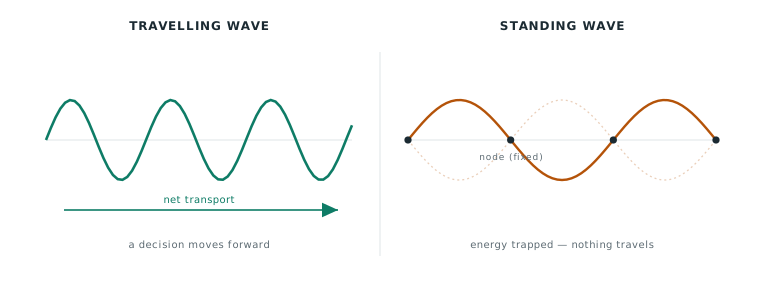 I'm really pleased at how this essay by Tom and me for FIELD STATION turned out. It's about decision making in the AI era, using some physics metaphors:
One of the first questions we ask new clients is "how do you make decisions?"
It's an important question. A group of people, however they're organised or structured, that doesn't know how it makes decisions will struggle to move forward. Some organisations implicitly or explicitly defer to whoever is most senior. Others believe they operate by "consensus". Increasingly, though, organisations are letting AI make decisions for them, and hiding the fact that they've done so.
There's nothing wrong with using AI to do your work. FIELD STATION builds and analyses things using AI; this piece was improved with AI assistance. But at some point a line gets crossed: the point where "efficiency" or "augmentation" becomes the reduction of a capacity to decide.
As I've said previously, there are a lot of pejorative terms bandied around about AI, which I don't think is helpful for gaining a clear-eyed view of what is going on.
A recent essay argued that some organisations are suffering from "AI mania", which distorts judgement rather than providing clarity. Plenty of individuals and organisations are getting real value from LLMs and AI agents in their workflows. We'd argue that's because they already know how to make decisions. It's easier for individuals to use AI well: they don't have to coordinate with anyone else before doing it. Organisations that aren't already good at coordination and decision-making tend to find AI more of a hindrance than a help.
Rather than the cognitive surrender some commentators describe, what's happening looks closer to an abdication of judgement. That's not new. Wanting someone, or something, to decide for you is a very old impulse: it relieves you of responsibility and gives you somewhere else to point when things go wrong.
AI doesn't change what's already there; it turns the volume up on it. Organisations that are already good at decision-making get better with AI. Processes speed up, and agents can run in loops on top of an already-shared understanding of what matters.
Source: FIELD STATION
Enjoyed this? Get new notes by email
A digest of new notes, daily, weekly or monthly. Confirm by email, unsubscribe any time. Prefer a feed reader? Subscribe via RSS.
Around this note
Grows from
Feeds into
Shares soil with
Suggested by AI from similar content
Since this was written, one newer note has drawn on it, most recently OrgLens: 2. Making an organisational health check people can actually use.