Universities have found the right levers on AI and assessment ... but they're pushing them the wrong way
The systems theorist Donella Meadows was fond of repeating an observation from Jay Forrester, the founder of system dynamics. People, he said, tend to know by instinct where the points of greatest influence in a system are – and then push them in the wrong direction (Meadows).
I'm pretty sure that fits higher education's response to generative AI uncomfortably well. While I'm no longer directly involved in formal education, my son is at university, and so I have a window into student assessment. Viewed as a system with its stocks and flows and feedback loops, it's possible to consider where we might intervene if we wanted to change the outcome rather than manage how it looks.
TL;DR: the sector has found the right places to push. Unfortunately, much of the pushing goes backwards...
Draining the stocks
What is a degree? In an important sense, it's a promise from a reputable institution that this person can do particular things. The word credential shares a root with credence: at bottom it means "credibility by association", which is why the trust networks around an award matter as much as the award itself (What is a 'credential' anyway?).
In the language of systems thinking, we can think of two "stocks" sustaining that promise: assessment validity (the evidence that the award measures what it claims) and graduate capability (the thing the award is about).
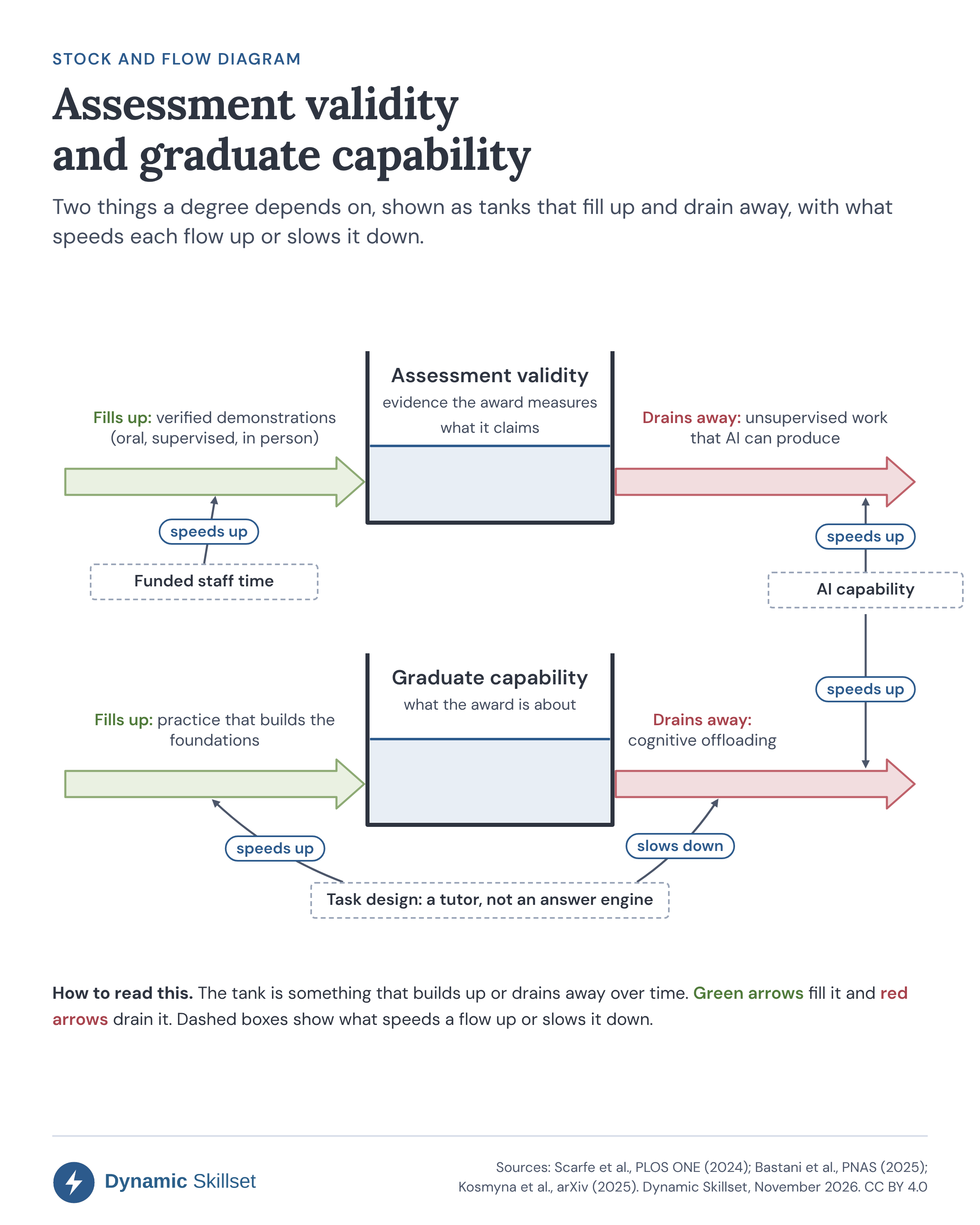
AI drains both of these stocks. The validity drain is well documented. For example, in 2024 researchers at the University of Reading submitted work written entirely by AI, without markers knowing, across five undergraduate modules. Markers missed 94% of it, and the AI scripts scored on average half a grade boundary higher than real students (Scarfe et al.).
So, it's fair to say that, as an instrument, the unsupervised written assignment is an entirely broken model whether or not any individual student cheats. Students back this up: in Wonkhe's survey of 1,055 students across 52 UK providers, 38% admitted they sometimes submit work they couldn't fully explain (Dickinson and Marshall).
Turning to capability, this "drain" is newer and perhaps more contested. The MIT Media Lab's EEG study found that people writing essays with an LLM showed the weakest brain connectivity of three groups and struggled to quote what they had just written. The sample is small and the paper is a preprint, so it deserves a cautious reading (On deskilling, mis-skilling, and never-skilling).
Firmer evidence, though, comes from a field experiment with nearly a thousand secondary school maths students in Turkey. Unrestricted GPT-4 access improved their practice scores and left them doing worse in exams than peers who never had it. A version built to tutor, rather than hand over answers, largely avoided the harm (Bastani et al.). So what's the lesson here? The harm follows the design of the task.
A policy that "solves" AI cheating and leaves unsupervised written assessment in place might catch every cheat but still certify capabilities that have never been built. That's not greate.
The detection loop
David Ross's "classroom AI doom loop" is a clear-eyed way of summing up the risk: teachers use AI to set work, students use AI to do it, teachers use AI to mark it, and, as a result, nobody learns much (The Classroom AI Doom Loop). My concern isn't the use of AI in teaching and learning, it's the unthinking embedding of these tools into a model of assessment that's inherited and industrial. I'm interested in the systemic side of things rather than proving whether one particular student "cheated" or not.
Without changing the assessment model, many people turn to "AI detectors". The trouble is, these so-called detectors actually misclassify non-native English writers' work as AI-generated far more often than native speakers' work. In addition, simple rewording utterly defeats them (Liang et al.).
Research by the QAA found that students add deliberate errors to seem "human" and hold back from declaring AI assistance even if they were allowed to use it (QAA). Brendal Aformeziem has explained what this means for international students in UK universities, where detector scores (like lie detector tests in 20th century courtrooms) often carry weight in misconduct cases. Even Turnitin says this isn't a good idea! (HEPI). Sarah Elaine Eaton argues that institutions adopted detection tools to protect integrity but end up penalising difference (Eaton).
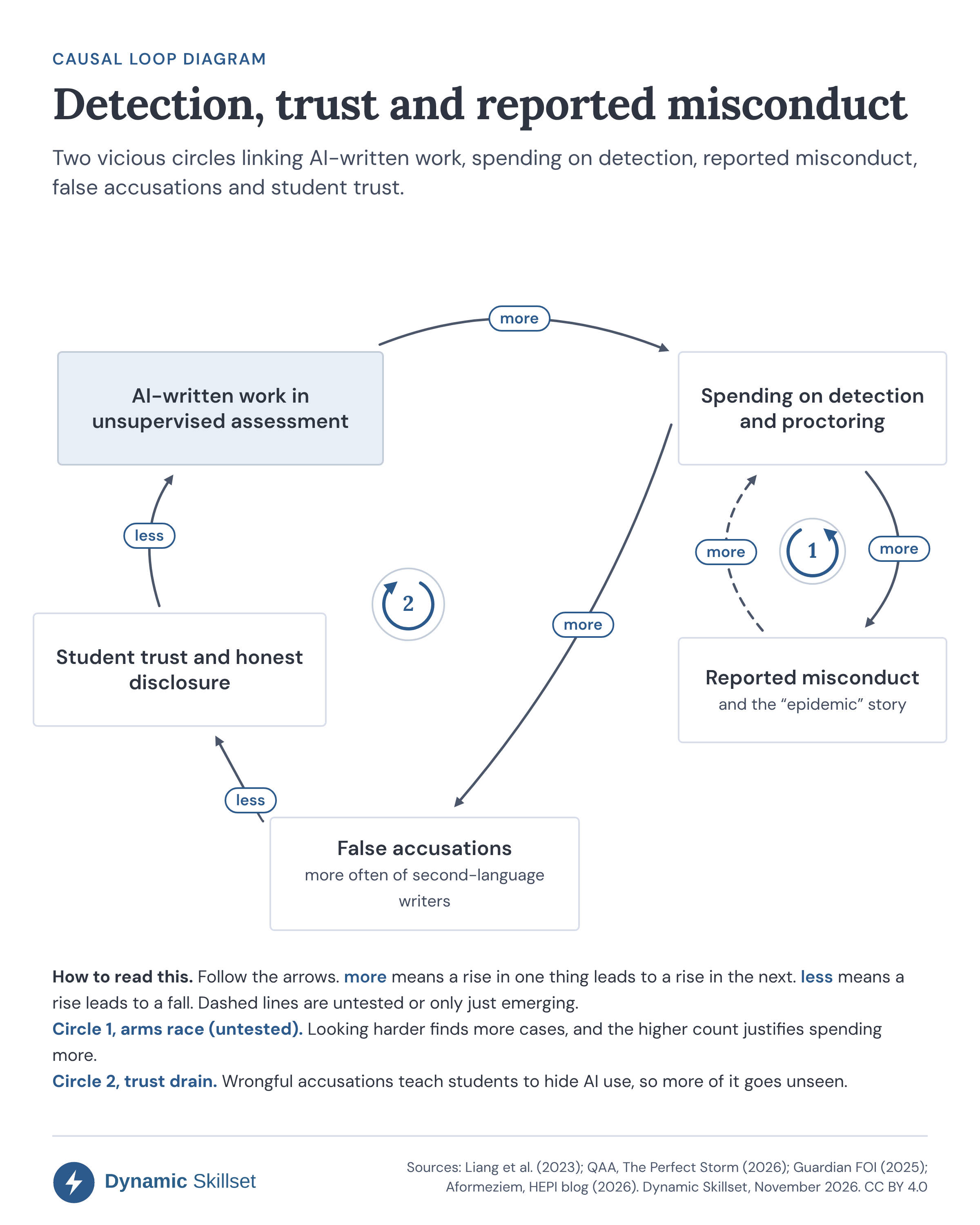
There are two reinforcing feddback loops that result from this. In the trust "drain" (R2), each false accusation simply teaches students to hide AI use. That means more of it goes unseen, which raises the alarm – and the budget.
The arms race (R1) is a hypothesis I would love someone to test. The Guardian found almost 7,000 proven cases of AI cheating in 2023-24, or 5.1 per 1,000 students. More than a quarter of the universities that replied didn't record AI misuse as its own category (Academic Misconduct Index) meaning those numbers measure recording and detection effort as much as behaviour. Institutions that look harder to find AI misuse find more, so the headline figure justifies the next purchase in detection software.
Note that neither of these loops helps with assessment validity or graduate capability.
One loop that actually restores trust
There is a balancing loop is available here: assess the person rather than the artefact. Oral exams and supervised tasks restore the evidence linking a person to the capability they claim; explaining your reasoning out loud is itself a way of thinking.
Wonkhe's research is perhaps the strongest UK evidence for this. They found that the thing that changed how students used AI was whether they would later have to have to show they understood what they'd produced. My son has a presentation next week where he's used AI to create the slides and perform some of the research. But he has to stand up there and answer questions about it, and he doesn't want to look stupid.
Jim Dickinson and Mack Marshall call this the "accountability moment", with their data pointing to assessment design instead of AI policy as what decides whether students use AI to learn instead of cheat (Wonkhe).
It's interesting to note that the doctorate has always worked this way. I submitted a thesis in late 2011 and the decision to award my doctorate was made in a viva (What is 'digital literacy'?). The education system has always known how to assess the person. But, at scale, it decided it couldn't afford to. QAA's own report notes that the formats the sector is now reaching for are among the most resource-intensive available, at a time of tightening budgets.
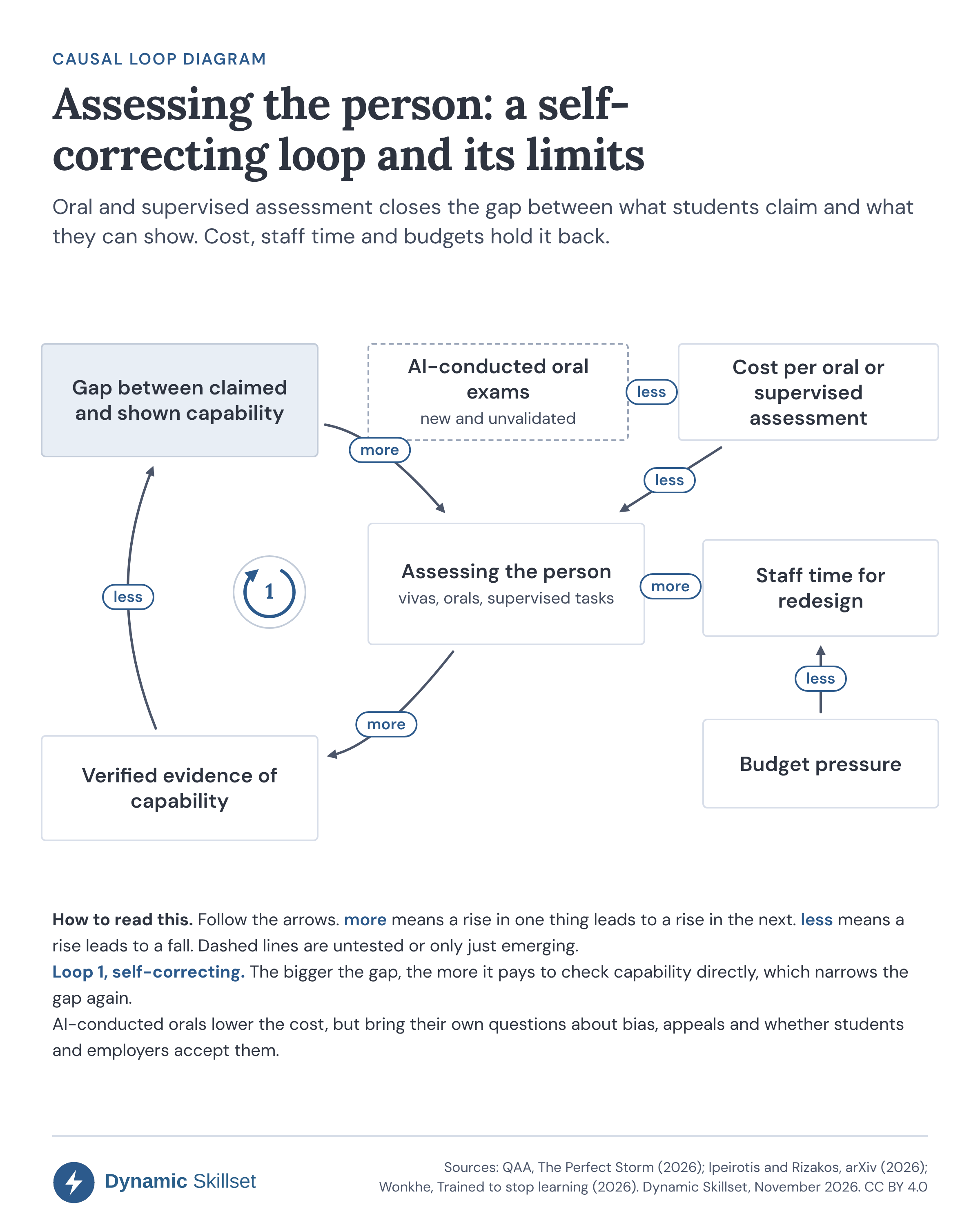
However, that cost constraint is starting to shift a little. At NYU Stern, Panos Ipeirotis and Konstantinos Rizakos built a voice agent that runs a personalised oral exam, with three LLMs grading the transcript. In its first run, it examined 36 students for a total of $15 (Ipeirotis and Rizakos). Their paper is candid about what didn't work: the agent stacked several questions at once, couldn't randomise cases, and a voice cloned from the professor came across as aggressive. Nevertheless, fully 70% of those students agreed it tested real understanding.
Machine-run, high-stakes assessment raises important questions about bias and appeals processes that nobody has fully figured out yet. There's also a bigger question about legitimacy. Audrey Watters has spent years warning against edtech that arrives with a ready-made fix, and her warnings apply here (Watters, via NEPC).
Even so, the technology that broke written assessment might be lowering the cost of its replacement. That means the question moves from whether we can afford it to whether we can make it legitimate.
The risk, I think is that we end up with human vivas for an elite few, and AI vivas for everyone else. It's a plausible outcome of the direction we're headed, but probably a corrosive one.
Where should we push?
Donella Meadows, mentioned earlier, ranked 12 places to intervene in a system, from parameters at the weak end to paradigms at the strong end. If we map these onto assessment, most of the sector's energy sits at the low end of the list with things such as detector thresholds, penalty tariffs, and AI declarations.
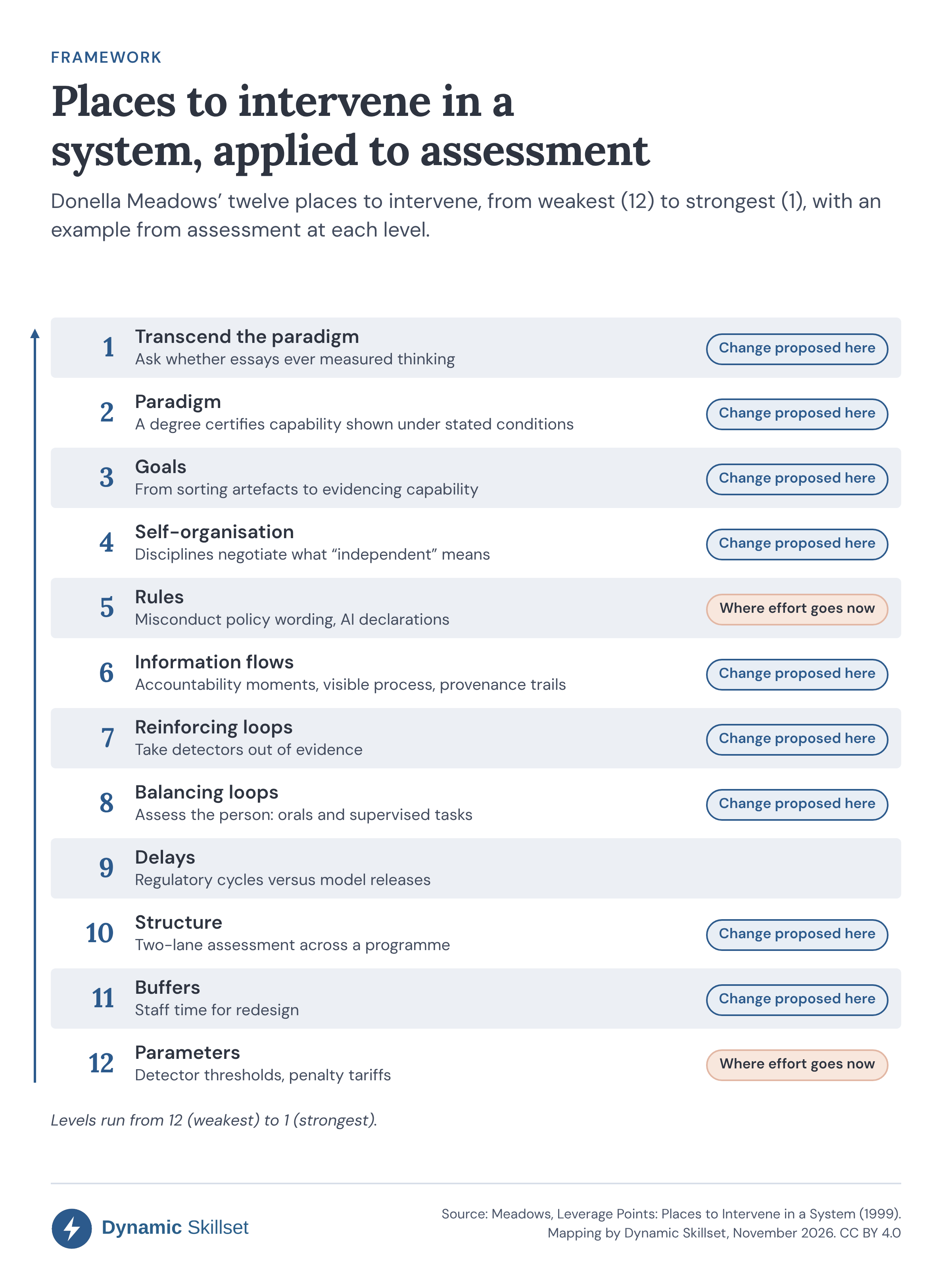
Provenance tools are a step up from detection. Inkk, which I discussed recently with co-founder Will Randell, runs on the student's own computer and can be switched on and off from the menu bar. It keeps a record of where anything copied and pasted into a document came from, and the writer chooses who to share that record with (Inkk).
What I like about this approach is that it puts the evidence in the student's hands. It's akin to a reference list, and it's much better than a guess by AI detection software. It sits a little higher on Meadows' list, at the level of information flows. But it doesn't change the system, because a record of how an essay was put together still tells you about the artefact, and the goal of assessment stays where it was.
Earlier this month, the Office for Students in the UK published research with Advance HE calling for far greater use of secure, AI-free assessment. It specifically named in-person exams, presentations, and vivas (THE). That shows a way to get the system back into a balancing loop. The danger, however, is that a regulator worried mainly about reputation rebuilds the system of closed-book exams. Karen Coate has already argued that a whole-institution return to in-person exams would be the worst thing the sector could do (THE).
Thankfully, there are three interventions that sit higher up Meadows' list.
1. A two-lane approach: secure assessment and open assessment
At The University of Sydney, Danny Liu and Adam Bridgeman have developed a two-lane approach that separates secure assessment, which verifies what each student can do, from open assessment, where AI use is expected and the process is visible (Sydney). The Universiy of Bath has announced they are moving to this system from next academic year (Bath). Its structural value is that it stops asking one assessment to do two jobs: verifying the person and supporting their learning.
2. Treating undeclared AI use like a missing citation
Students are scared of declaring their AI use because of the potential penalties. If, instead, undeclared AI was treated like a missing citation rather than a "crime" then students would be less fearful of false accusation. Thomas Corbin, Phillip Dawson and Danny Liu point out that rules students are free to ignore (e.g. traffic-light categories and declarations) are discursive changes and do little on their own (Corbin et al.). Norms around disclosure occur when they sit alongside structural changes, like the "accountability moment", which alters what a task actually asks of a student.
3. Validity as the thing regulators look at
Dawson and colleagues argued in 2024 that validity matters more than cheating (Dawson et al.). QAA's draft principles for the sector now ask whether assessment still provides valid evidence that students have met the standards of their award (QAA). If we read these two things together, they describe a paradigm shift sititng underneath all of this: a degree certifies capability demonstrated under stated conditions. And those conditions can include AI.
None of these three interventions work without staff time. Every redesign assumes academics have hours to rethink assessment, at the same time as budget cuts push towards standardisation.
In my doctoral thesis, I made a related argument about definitions. Chasing a single 'correct' definition of digital literacy turned out to be a trap; what mattered was co-constructing one based on local context (What is 'digital literacy'?). The same applies to "independent capability". This is something that should be negotiated discipline by discipline, with the people being assessed, and that negotiation is how the reform really beds in.
Did the pre-AI system do what we said it did anyway?
The research at the University of Reading showed that AI-generated scripts beat real students by half a grade boundary. That makes clear what is rewarded in assessemtn through unsupervised essays. Ethan Mollick warned of a "homework apocalypse" in 2023 and has since said the prediction came true (Brake, on Mollick). Stephen Downes argues that the AI debate keeps skipping the question of what education is for (Downes). Both of these point to the top of Meadows' list: just how much of the pre-AI system measured the capability we said it did?
If you're interested in a fuller analysis, I'm still working on a kind of 'report'. No-one's paying me to do it, though, so it might take a bit longer. And yes, of course I'm using AI to help me with research. And I'm happy for you to test me on any of it!
Top image: David Birozy
Enjoyed this? Get new notes by email
A digest of new notes, daily, weekly or monthly. Confirm by email, unsubscribe any time. Prefer a feed reader? Subscribe via RSS.
Around this note
Grows from
Shares soil with
Suggested by AI from similar content