Trying to be less of an AI hypocrite

Yesterday, I was down in Leeds for Product for the People 10, which was all about sustainability. Ironically enough, given the focus of this post, in order to attend I had to postpone a talk entitled Environmental Justice: Why do people default to Big AI?
The talk is based on talking through this system dynamics diagram:
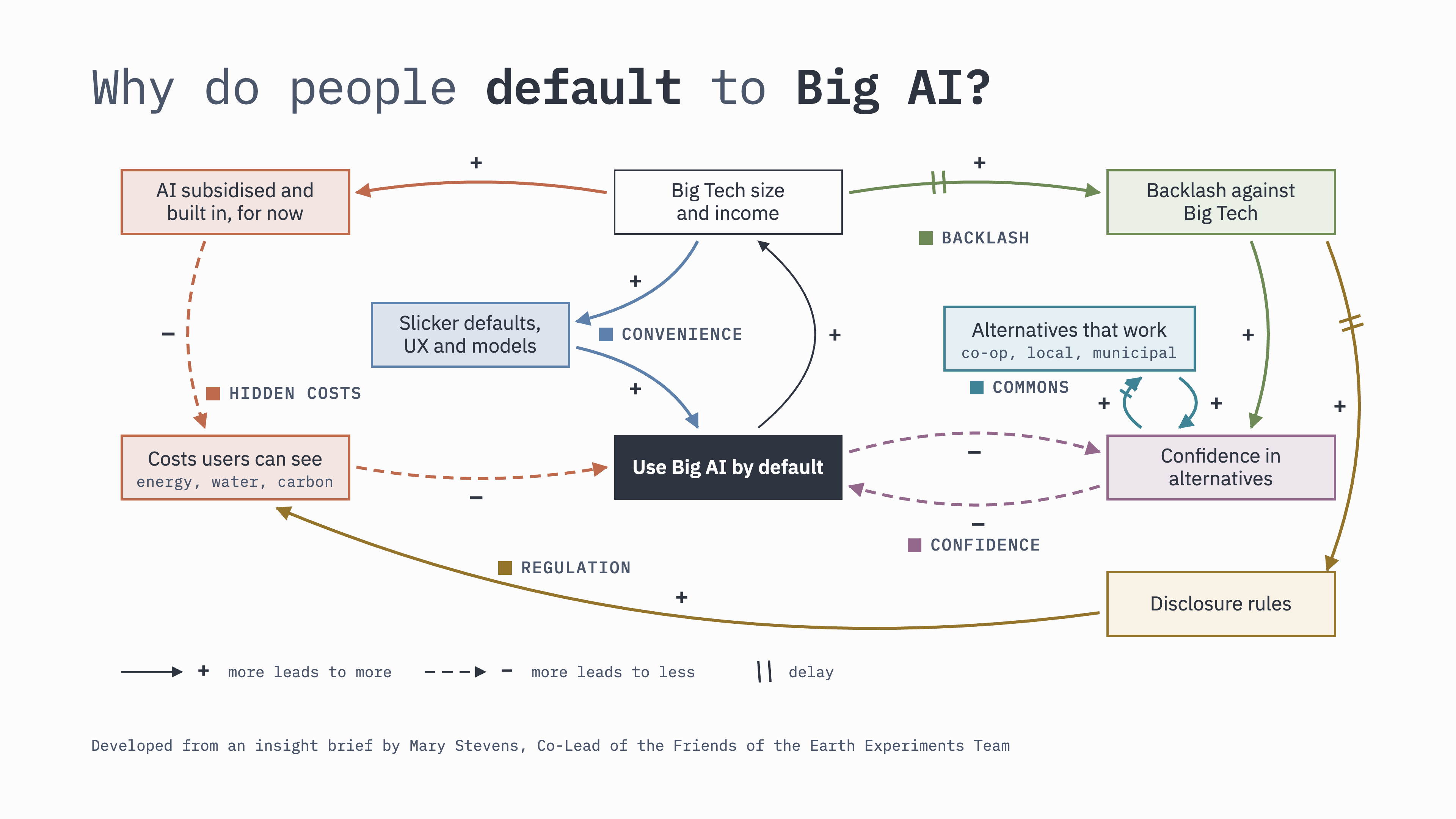
I am, just like everyone else, susceptible to the pull of Big Tech. Although try my best and have moved from Google to Proton for Dynamic Skillset, and FIELD STATION is running on infoManiak's kSuite, when using AI, I've found myself using mainly a mixture of Perplexity and Claude.
After last week's Just Enough AI event down in Bristol, I was already feeling bad about using Big AI, so last weekend I started moving back to OpenCode, which I'd been dabbling with as a harness. The following diagram is a really simple overview from the presentation I gave at the Bristol event which explains some terminology:
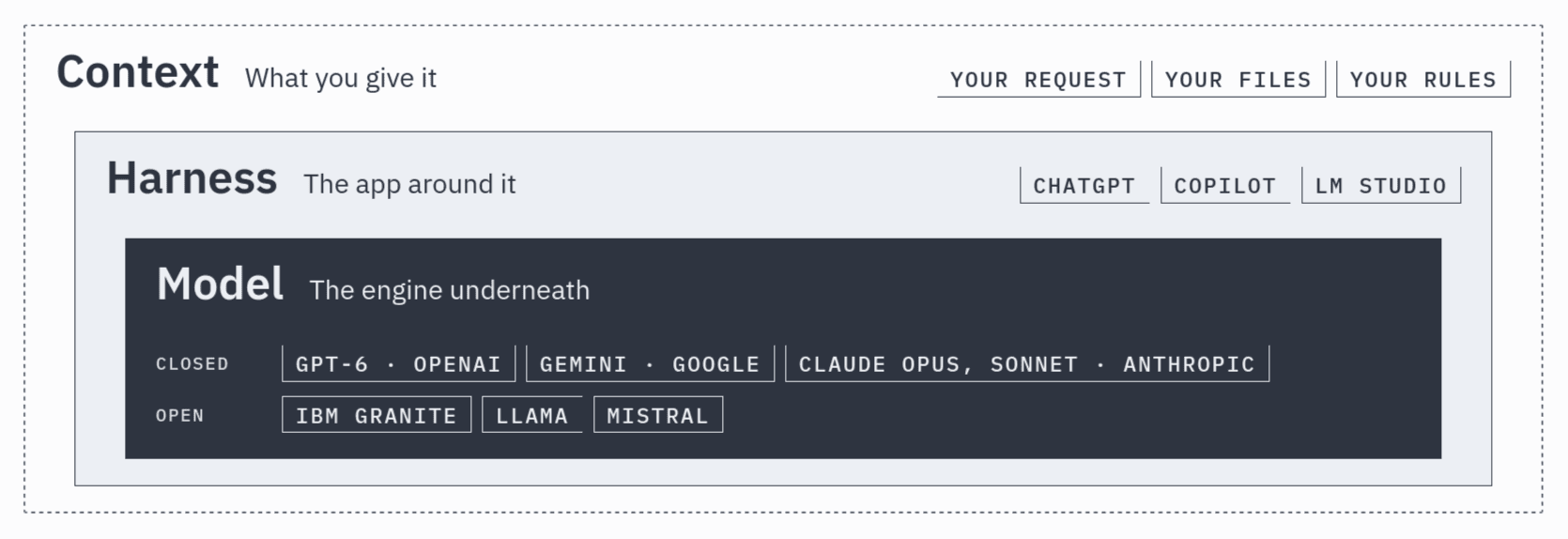
For more on the AI 'stack' read The Sovereignty Stack Has No Bottom, but for the purposes of this post, lets stick with this simple view. There's a reason that Anthropic had the largest IPO in history this week: its Claude product it makes it really easy to not have to think about any of this. You get the productivity, and the externalities happen somewhere else.
The problem, as Mark Butcher reminded us all during an excellent talk at the event in Leeds yesterday, is that Anthropic is now using the same extremely polluting data centres that Grok uses. That includes Colossus, which is mind-bogglingly bad for the planet. The site uses many gas‑turbines and draws drinking water for cooling.
While I knew this, there's a stark difference between reading information when by yourself in your home office, and being confronted by it when someone is presenting to an event about sustainability. Combined with the event in Bristol last week, I felt complicit.
Mark used a lot of facts and figures in his presentation, some of which I'd seen and some which I hadn't. One of the things he talked about was a "PUE" number, which stands for power-usage-effectiveness. He said the data around this can be problematic, but at least it's a start. He also mentioned that the French electricity grid, which is low carbon (primarily nuclear and renewables), is a good place to be running your AI inference.
The carbon benefits of going with OVH Cloud
I've was already using OVH cloud for my VPS to host various websites, including this one. And I've already been using their AI endpoints for various things, including the tools I've been developing. So I wanted to see whether it would be a good default option for me.
I'd already done some preparatory work by creating an llm-wiki using loqseq on a headless Mac Mini I keep running in a cupboard. If that means nothing to you, don't worry: basically I used a program running on a different machine on my network to automatically update the context based on my conversations. It works well.
There are other options than OVH, and you should do your own research. Also look at Scaleway, which is another French provider, and infoManiak, which is Swiss. The latter claims to be run entirely on renewables and use the heat generated from its data centres to heat homes.
You can't compare data when there are no numbers from a particular source. Like all Big AI companies, Anthropic doesn't publish lifecycle data, so the carbon cost of each request can't be verified. OpenCode has a built-in service called OpenCode Go which you don't have to use, but they make it very easy to do so.
OpenCode doesn't reveal where the hardware is located. So without that information, it's impossible to make a reliable emissions estimate. So all I can do is talk about what I'm moving to with OVH. Operating in Gravelines, France, OVH publishes PUE data (≈1.21), runs on 100 % renewable electricity, and provides a full life‑cycle impact tracker.
The French electricity grid emits about 48 g CO₂e per kWh, which is roughly one‑tenth of the average US grid (≈ 380 g CO₂e per kWh). So even just with that, we've got a pretty solid baseline for a more environmentally responsible setup. Yes, using no AI would be even more environmentally responsible. I agree.
Creating a model ladder in OpenCode
AI is actually pretty good at configuring itself. So after a bit of prompting (admittedly using Claude, Perplexity, and Proton's Lumo, as well as varoius models in OpenCode), I've come up with the following default with the idea to start with the smallest model that can finish the task, and then move up only when the smaller model fails.
Everyday work – Mistral Small 3.2 (24 billion parameters).
This model can handle text and images, provides a 128 k token context window, and costs about US $0.10 per 1 k input tokens and US $0.31 per 1 k output tokens. Mistral publishes a lifecycle figure of roughly 1.14 g CO₂e for a 400‑token response, which works out to about 0.6 g CO₂e per 1 k tokens.Heavy reasoning / very long documents – Qwen 3.8‑27 B.
This model provides a larger (262 k) token context window and stronger reasoning. Price is about US $0.47 per 1 k input tokens and US $3.19 per 1 k output tokens. So, a lot more expensive. As it runs on the same French infrastructure, the carbon intensity stays low – around 2 g CO₂e per 1 k tokens.Single‑image tasks – Qwen‑VL‑30 B.
This model is just for vision - i.e OCR-type activities. Cost is roughly US $0.15 per 1 k input tokens and US $0.58 per 1 k output tokens, with emissions near 0.3 g CO₂e per 1 k tokens.
What happens if these models can't do the job? Then I'll move to a more frontier-like model such as DeepSeek. I need to figure out where exactly I'm going to run that, as although it's easy to do via OpenCode Go or OpenRouter, I want to do so in a way that fits with my more sustainable approach.
If you're looking to do something similar, you should be able to do everything required by prompting a model in the OpenCode app itself. You shouldn't need to touch the terminal.
Next steps
I'll let you know how I get on. You can tell this is important to me, as I'm going to be publishing this post at almost 3am on the morning after the event. I couldn't sleep, so I got up and sorted it out.
There will be some trade-offs, of course there will. I've been so productive recently using Claude, and particularly Claude Code. But I reckon I can get 80% of that done using this new system, and can perhaps nudge that effectiveness up a few nudges through various tweaks.
Ethical issues are never binary, and pretending they are doesn't particularly help things. One quotation that helped me ever since stumbling upon it during my teenage years (even before studying Philosophy at uni) was this one from Mahatma Gandhi:
Happiness is when what you think, what you say, and what you do are in harmony.
I'm not sure I'm 'happy' with this setup, but I'm certainly happier than feeling guilty about using Claude Opus 5.5 for most things...
Top image: CC BY Marcin Wilkowski
Enjoyed this? Get new notes by email
A digest of new notes, daily, weekly or monthly. Confirm by email, unsubscribe any time. Prefer a feed reader? Subscribe via RSS.
Around this note
Grows from
Shares soil with
Suggested by AI from similar content