
To philosophise is to learn how to die
 As I've grown older, I've realised that one of the joys of reading is not only to discover new books but to re-read and re-discover ones I've read before. Just as listening to a song when you're in love is different to when you're not, so (as I've commented before somewhere) reading a book at one age is different to reading one at another.
I first started reading Michel de Montaigne in my early twenties and now, in my forties, I'm midway through the period of his life when when Montaigne not only retired from public life, but from family and social life too. He started writing about things befitting a 'gentleman' like what a good soldier looks like, but then turned inwards. The inscription he put above the bookshelves in his library reads:
In the year of Christ 1571, at the age of thirty-eight, on the last day of February, his birthday, Michael de Montaigne, long weary of the servitude of the court and of public employments, while still entire, retired to the bosom of the learned virgins, where in calm and freedom from all cares he will spend what little remains of his life, now more than half run out. If the fates permit, he will complete this abode, this sweet ancestral retreat; and he has consecrated it to his freedom, tranquility, and leisure.
One day, I hope to go and see his library, which has remained intact in the 400+ years since his death.
The essay "To philosophise is to learn how to die" is one of my favourite of his, as it serves as a useful corrective to our 21st century world, where we avoid talking about death. Montaigne instead suggests that we should think about, and discuss it, often:
To begin depriving death of its greatest advantage over us, let us adopt a way clean contrary to that common one; let us deprive death of its strangeness; let us frequent it, let us get used to it; let us have nothing more often in mind than death. At every instant let us evoke it in our imagination under all its aspects. Whenever a horse stumbles, a tile falls or a pin pricks however slightly, let us at once chew over this thought: ‘Supposing that was death itself?’ With that, let us brace ourselves and make an effort. In the midst of joy and feasting let our refrain be one which recalls our human condition. Let us never be carried away by pleasure so strongly that we fail to recall occasionally how many are the ways in which that joy of ours is subject to death or how many are the fashions in which death threatens to snatch it away.
Montaigne isn't uncommon amongst philosophers, especially of the Stoic stripe, in suggesting that philosophising is a useful preparation for death. Epictetus, for example, reminds us that "death and exile, and all other things which appear terrible [should]be daily before your eyes, but chiefly death" as this will mean we "never entertain any abject thought, nor too eagerly covet anything".
What I find different about Montaigne, compared to other writers who can loosely be thought of as Stoics, is that he shares his emotions and state of mind with us. He's also not afraid of painting a picture of himself as being somewhat weak (as we all are, really):
Being a man who broods over his thoughts and stores them up inside him, I am always just about as ready as I can be: when death does suddenly appear, it will bear no new warning for me. As far as we possibly can we must always have our boots on, ready to go; above all we should take care to have no outstanding business with anyone else.
I love phrase "we must always have our boots on" as a reminder that, whether or not we think it likely, death or serious illness, can come upon us at any point. My own life has been turned upside down in the last 18 months due to a medical condition which I'm hoping will turn out to be temporary. It's abundantly clear that I was not mentally prepared for this; my "boots" so to speak weren't even on for what, in the wider scheme of things, is only a small setback.
A good example of a line from this essay that I did not understand properly in my twenties, but I very much do in my forties, is this one:
I want Death to find me planting my cabbages, neither worrying about it nor the unfinished gardening.
We can take this quite literally, that it's better to be "taken" while being busy working. But we can also take it metaphorically to reinforce the point Montaigne makes earlier about having one's boots on, ready. In that sense, the "unfinished gardening" is the rest of other people's existence, and the world that continues without us once we've gone.
I always used to wonder what the fascination with gardens was for older people. But I get it now: it's a microcosm of the world – a place that you can shape over the short and longer term, but also one that existed before you started paying attention to it, and which will exist once you've gone. Whatever impact we have is temporary and, at the end of the day, for the enjoyment of ourselves and the people we love.
For all of his "brooding", I find Montaigne nevertheless an optimist about the world. There's something very modern about the way he talks about what might be termed the width as well as the length of our lives:
The usefulness of living lies not in duration but in what you make of it. Some have lived long and lived little. See to it while you are still here. Whether you have lived enough depends not on a count of years but on your will.
One of the joys in my own life is to be "in conversation" with people like Montaigne, even though we have resided on this earth centuries apart. I happen to live in a gloriously stupid time, something I'm sure he thought of his own times, as references to civil wars pepper his work. Ultimately, although death may have felt much closer for Montaigne (only one of his six daughters survived, and his best friend died of plague) everybody has to come to terms with death at some point.
We get used to older people we know dying, but that is very different to getting ready for our own death, something that really could happen at any time. Yet like an unpaid bill we don't want to think about, we consider it a topic for another day, rather than something that, ultimately, our life is tending towards.
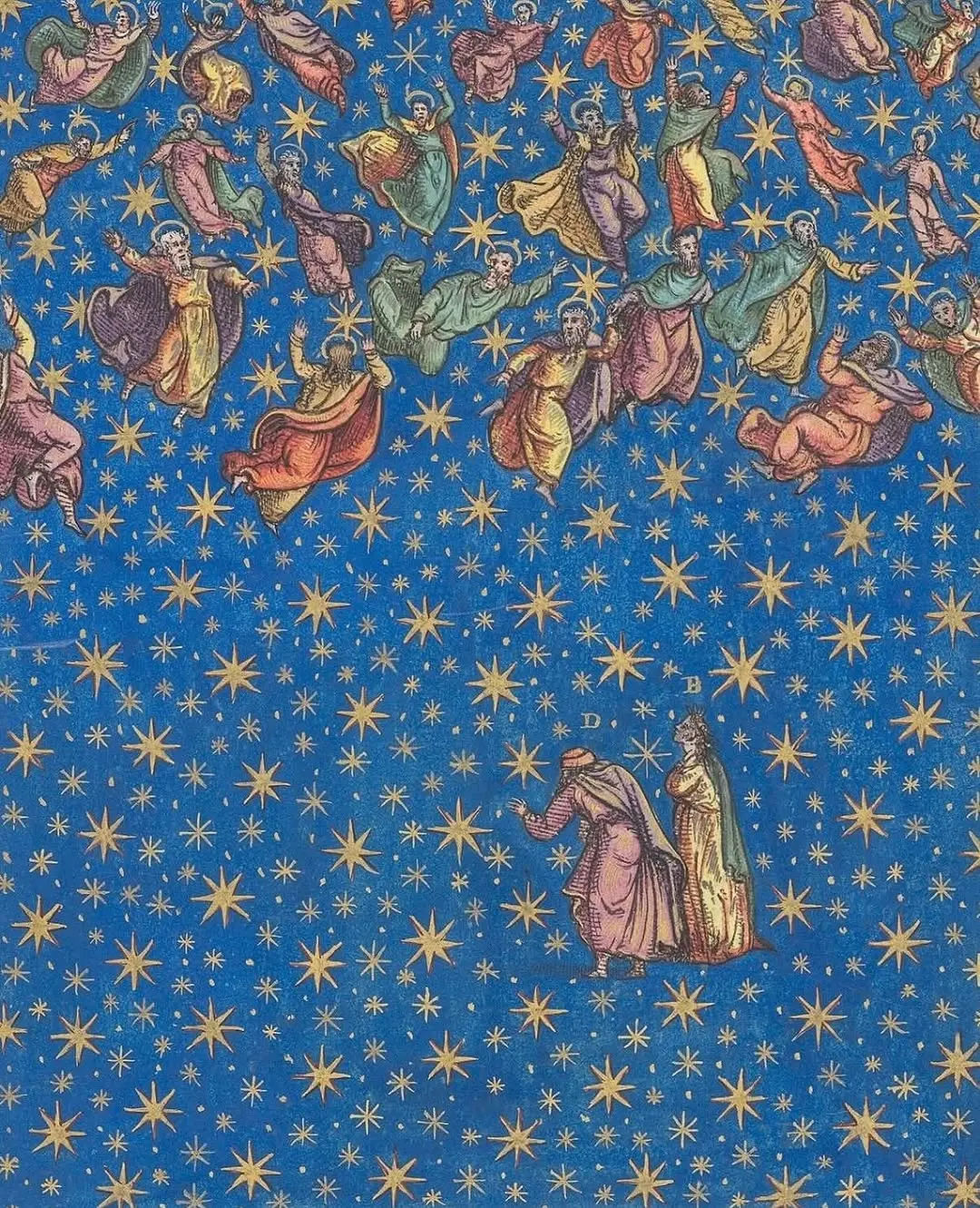
Image: Panel from a 16th-century Venetian edition of Dante’s Divine Comedy