
INTERNET OPERATOR: metonymy, icons, and idolatory

This is going to be a long-ish note, primarily because I'm going to be quoting at length from Jay Springett's excellent INTERNET OPERATOR zine. As you can see from the gif above, I've given it the highlighter treatment, pulling out things which resonate with me.
A lot of what makes INTERNET OPERATOR cohere so well is Jay's background in the Philosophy of the Arts. In particular, he illustrates his argument using references to puppetry, from Punch and Judy shows through to Bunraku. However, I'm going to rip Jay's words out of that context for my own purposes, as I think he's making interesting points for those of us interested in new literacies.
So as not to bury the lede, Jay argues for the following equation:
Figure + Operator + Audience + Apparatus = The animation of an identity
What that means in practice is that, whether human or otherwise, identity is co-created with an audience. Jay is related, but different, to his online persona @thejaymo in a similar way to Bruce Wayne and the Batman. Note that we don't need a human consciousness involved:
Now place the AI persona inside the equation.
The figure is the chatbot or agent as it appears: it has a name, a voice, a manner, avatar, and conversational continuity turned towards a user.
The operator is a composite one. It includes all the people and institutions that trained, tuned, instructed, and deployed the model, together with it’s runtime harness: system prompt, memory, tools, permissions etc and the loop that keeps it acting. The harness supplies the immediate operation of the model, but it doesn’t yet fully animate the figure by itself.
The audience is the user, and sometimes a wider public. But it’s also complicated as the user also becomes a co-operator, because each turn in the conversation helps shape what this instance of the figure becomes.
The apparatus is the interface and wider platform through which the figure is encountered, distributed, and constrained.
[...]By the terms of this essay, the AI persona is a legitimately animated figure. We don’t need to establish either biological life nor subjective experience to treat it as one. All we can say is that with an AI agent figure, it enters into an active relation with the audience, making the persona socially present.
(p.27-28)
What I like about this is that Jay neatly sidesteps questions around agency and consciousness, replacing them instead with those around legitimacy and animation. Like me, Jay has lost a friend and, like me, thinks about his own digital legacy. Once a person has died, there is no longer any living animation behind their words or content, which lives on regardless.
This is one of the reasons why (Plato's depiction of) Socrates didn't like writing: unlike oral disputations, there's no way to refute a text. And 'text' in the 21st century covers everything from digital words on the screen through to video and other multimedia hyperobjects.
Even a dormant figure can become socially present again when somebody encounters it. An old post can be read. An abandoned profile can be addressed. A recording can speak after the person who made it has left the room.
One day the same will be true of @thejaymo. My blog might still load, and my episodes may still play. A sentence of mine may arrive in a room I can no longer enter. I will not be there to correct it, withdraw it, apologise for it, or answer for what it does.
(p.29)
While we are alive and able to stand behind our avatars in realtime, we can ponder the relationship between the two. We're now long beyond arguments whether the 'online' world is as real as the 'offline' world. As Jay recounts, it was over a quarter of a century ago when he "watched someone get glassed and badly injured over something they had said on [a] punk forum... Chat shit online, get banged in real life became the rule that organised my entire relationship to the early web"* (p.4).
So what exactly is our relationship between the versions of us we carry around in our heads, that which others interact with in "meatspace", and the projections which other people experience in virtual environments?
A brand assumes a managed surface. Performance assumes an actor taking on a role. Anti-digital dualism rightly insists that online life is real life. None of these vocabularies quite describe the relation between who I am as a person, and who I am as a figure online.
(p.4)
Jay identifies something I'd felt but hadn't thought clearly about before, that social media feeds have the "grammar of cinema, but the social structure of theatre". That is to say, social media encourages main character syndrome by adopting the "framing, soundtrack, montage, point of view, and the promise of a central protagonist". Instead of the one-way relationship of the cinema, however, posting your life to a feed requires the social validation obtained through a "present, responsive" audience that is "partly responsible for making the figure matter" (p. 7).
As such as we are what Jay calls "platform subjects":
The term is more useful than ‘creator’ because the platform subject is camera operator, editor, caption writer, distributor, and analyst of the metrics all at once. The viewer knows the clip was made for TikTok, Instagram, or wherever, and will be consumed there too. Social media’s apparatus is not outside the situation. It is wrapped around it and inside of it.
(p.6)
Whereas previously, photographs or videos might be shared of things happening offline, in the 2020s, things are created, staged, and produced almost entirely for social media feeds. It reminds me of this, which I came across via Are.na:
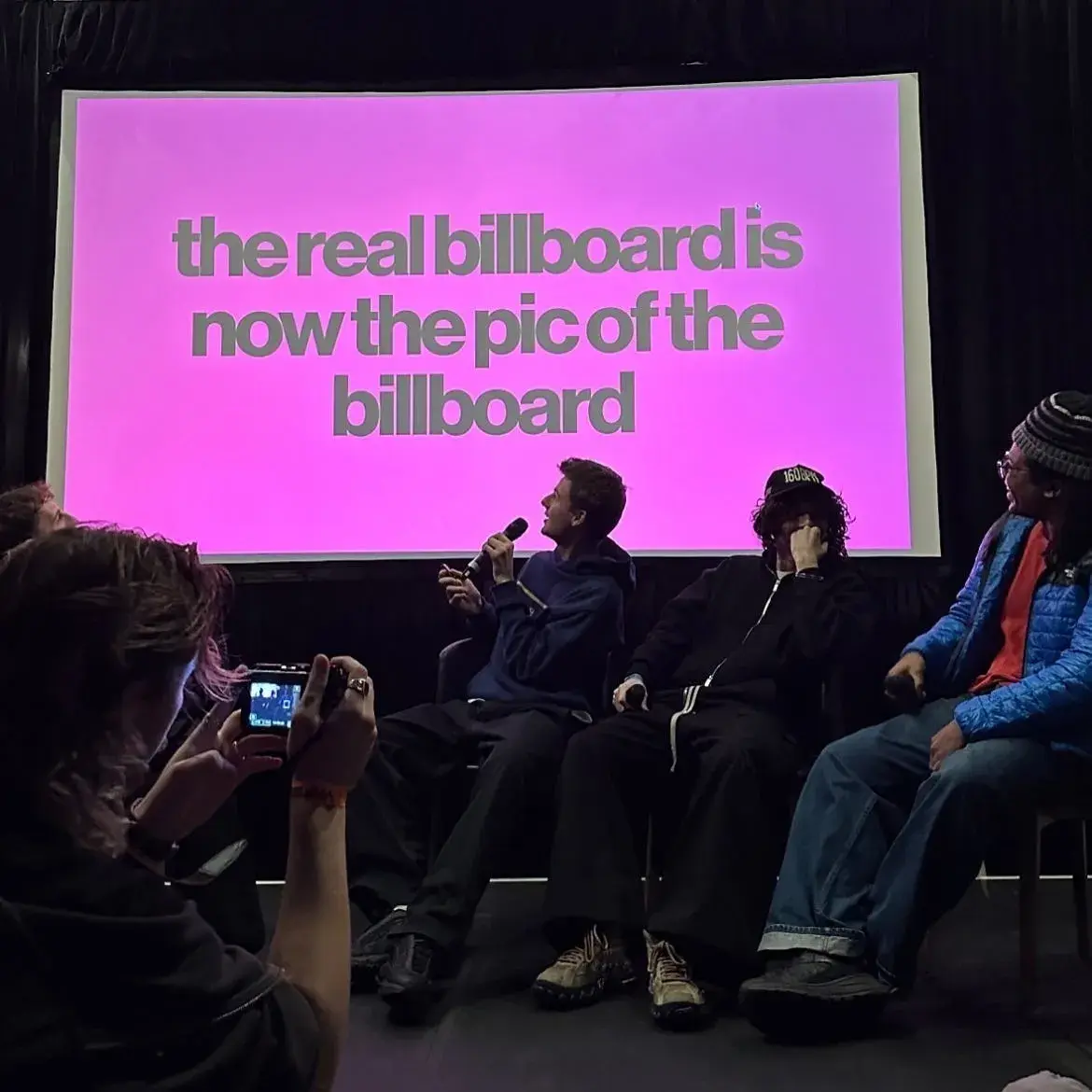 This is, quite obviously, a very different way to live one's life to our ancestors. And not just because of the technological element; people just didn't think that their actions were completely their fault:
Before the Reformation, people were not generally imagined as the sole authors of their actions. They could be moved by spirits, rituals, demons, grace, and powers and principalities beyond themselves. People’s personalities and actions were understood to be influenced by all, or part, of that list at any moment. In ancient Greek, especially in Homer, emotions were often described less as properties a person possessed and more as forces that came upon them or were with them. Charles Taylor calls this the porous self: an experience of personhood in which being moved is part of being alive rather than an interruption to it.
(p.14)
Animating an online avatar by being a platform operator is an "interesting" default life for people growing up in the 21st century. What does it mean to life an "authentic life" when much of our interaction with others is online, but the figure we create can be "addressed, archived, deleted, and even outlive" us? (p.15).
This figure is "not identical to the operator, but neither is it separate from them" (p.16) which creates an interesting tension between the two. The distance between the "figure" and the "person at the desk" can be small, or in some cases, great. As Jay points out, "[t]he right amount of distance between self and online figure is different for everyone; it is not a midpoint on a scale" (p.25).
Distance can also become disavowal. An operator may retreat so far behind a figure that they refuse to answer for it: it was only an account, a character, a brand, or a model. They keep the benefits of operating while abandoning responsibility for its effects. People who feel no remorse for cyberbullying or cancel-culture pile ons do this in reverse.
(p.25)
One of the "aha" moments for me in reading (and re-reading) INTERNET OPERATOR was Chapter 8 in which Jay talks about the difference between metaphor and metonymy. The latter is close to the idea of a zeugma which I used in my doctoral thesis, where I argued that one is never sure where the emphasis is, or should be, placed with terms such as "digital literacy". Is it DIGITAL literacies, or digital LITERACIES? The difference is important and makes a practical difference.
"Metonymy" is an umbrella term for a related group of terms, including synecdoche, which we're familiar with in everyday life – for example, when someone says they've got a "new set of wheels" to mean a new car, or that the committee "needs fresh blood" to mean different people and fresh ideas.
Whereas metaphor is a figure of speech comparing one thing thing to another thing by saying (or implying) they are the same in order to make the meaning clearer, metonymy, substitutes an attribute of an object for the thing itself.
Metaphor and metonymy do different jobs. A profile may look like a metaphor for a person at first glance, but it behaves like a metonym. It doesn’t just resemble or represent a figure: it belongs to the systems through which they can be recognised, contacted, refused, or even removed.
[...]
A handle is not a metaphor for the user; it is one of the user’s reachable surfaces. A brand account is not just a representation of the brand; it is part of the brand. When a profile carries relationships, income, memory, or access; deleting it, or having it deleted, is less like taking a picture down from a wall, and more like an amputation, losing a part of ones self.
(p.19)
This is such an important insight, and worth the price of admission alone. Usually, Jay reflects, we frame authenticity as "asking if the representation matches the referent" but considering things metonymically means asking "how well the representation points back to the referent" (p.20, my emphasis).
Once you see a digital profile as a metonym, the question changes. It's not "does the figure match the real you?" but "where does the relation lead?" Does the currency of attention pass through the figure towards a person, community, or institution that can answer for it? Or does attention stop at the figure's surface?
(p.20)
This difference, Jay argues, is the difference between an idol and an icon. In the Christian religion, icons have been used to help believers: the "attention does not stop at the painted image of a saint hanging on the wall; it passes through the image through the saint, and toward a wider world of devotion" (p.20). That is in contrast to the idol, where "[a]ttention is captured at the surface" and where "[t]he figure itself becomes the thing addressed, loved, defended, and obeyed. It no longer opens onto a world; the surface of the thing becomes the world." (p.20)
And therein, I think, lies many of our contemporary problems. We have become idolatrous, not in a spiritual sense, but in the sense of our attention stopping at the surface and not thinking, caring, and addressing the things underneath the surface. This goes beyond ideas of the signifier and signified as the signifier self-referentially becomes the thing signified.
To me, it's a form of "model collapse", a term we use about AI models which are trained on outputs from other AI models. Similarly to cassette tapes being copied from other cassette tapes, quality declines the further we get from the source material and the original "signal" degrades. Too much time spent in algorithmic social media feeds can mean losing our sense of self, and replacing that with an invented one based on loyalty to a cause. As Jay puts it,
Sometimes distance collapses from the inside. You pour yourself into a band, game, or media franchise, until the attachment becomes part of your public face: a username, avatar, and way of being recognised. A good faith critique of the thing you have poured yourself into can then feel like an injury. Attention travels along the relation from franchise, to fandom, to profile, to person, to body. What looks from outside like a debate about media, feels from inside, like an argument over whether you are allowed to exist. The figure sits directly on the flesh.
There's so much more I could say about INTERNET OPERATOR, and I'm really glad that I have a physical copy of the zine. You can get your own from Jay's Etsy shop, and/or support him to ensuring that you get the next one!