
The elephant is coming towards us regardless of what we choose to do, or not to do
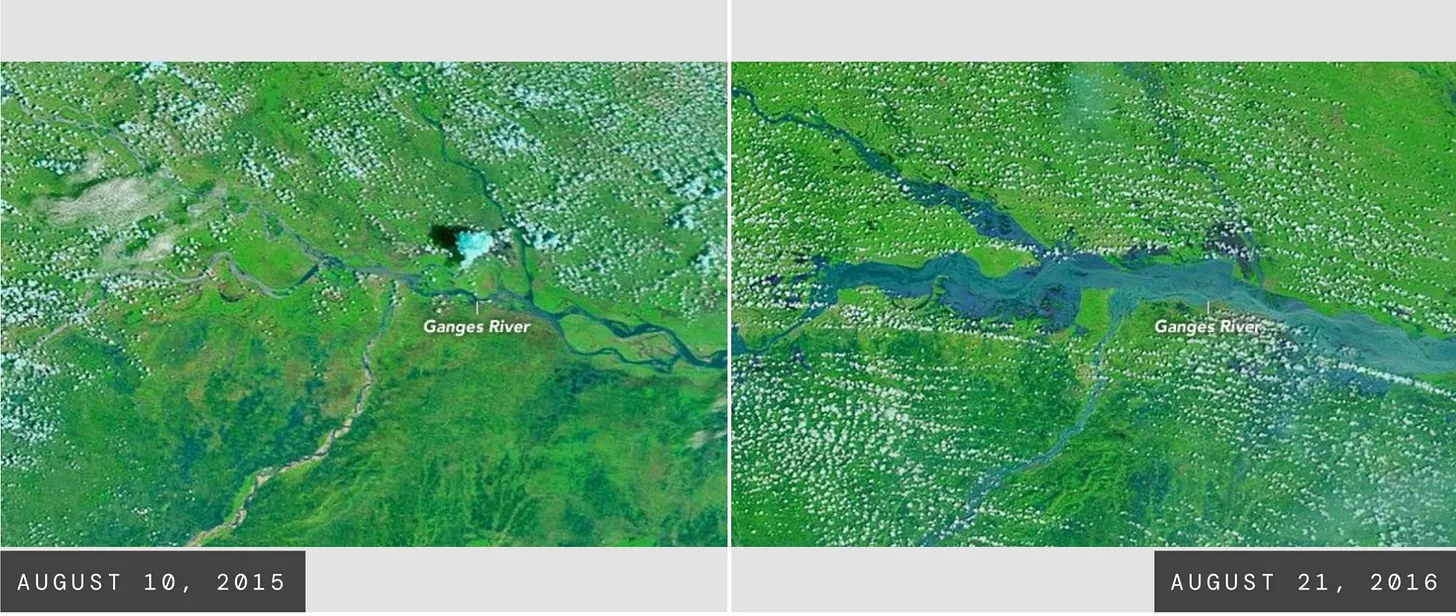 Andrew Curry summarises and adds to Art Kleiner's post about things we already know are going to happen in 2030. Kleiner channels Pierre Wack's idea of the “predetermined element” using the example of the River Ganges:
If there are heavy monsoon rains over the Himalayan headwaters, you can tell with certainty that there will be a flood five days later at Allahabad, which is 650 miles downstream. Five days after that, he said, the floods would reach Benares.
*> “Now the people down here in Benares don’t know that this flood is on its way,” he said, “but I do. Because I’ve seen it! This is not fortune telling. This is not crystal-ball gazing. This is merely describing future implications of something that has already happened.”
There's plenty of optimistic rhetoric around climate change with people saying that "the window is shrinking" for us to be able to stop irreversible effects on our lives. But, as this summer has already shown with its heatwaves in Europe, that ship has already sailed. Similarly, there are things coming down the metaphorical Ganges that we can't actually stop:
Peter Drucker, the management theorist, had a similar concept, of “the future that has already happened”, whose effects were still working themselves out and were not yet fully visible. And the black elephant in the “futures menagerie” has a similar function. The elephant is coming towards us regardless of what we choose to do, or not to do.
In Systems Thinking, it's common to differentiate between first-order and second-order effects, the latter being the effects that happen as a result of the former. With the Ganges example, the river flooding is a first-order effect. The impact on people and society might be the second-order effects.
Curry summarises some of the second-order effects that Kleiner suggests are already locked-in to life in 2030, given what's already happened so far:
- The climate crisis gets worse. Enough carbon has already accumulated that the global average temperature will cross 1.5°C above pre-industrial levels by the early 2030s. Extreme weather events will be more intense and more frequent.
- Water shortages increase. Enough groundwater is being permanently depleted, and enough reservoirs and snowpacks are being drawn down or shrinking, to make this a driving force.
- The planet’s biological impoverishment continues. Humanity will continue to encroach on the carrying capacity of the planet. Species extinction will continue to run orders of magnitude above the natural background rate. By the 2030s, we are likely to be personally affected by food shortages or loss of habitat.
- The human population balance tips. Enough of the world will have aged, enough birth rates will have fallen below replacement, and enough young people will have been born in sub-Saharan Africa that the species will be simultaneously old and young as never before. By the mid-2030s, almost all the net growth in the young-adult workforce will be African.
- The energy system flips. In general, adoption of new technology is determined not by innovation itself but by factors related to demand. These factors all favor renewable energy. Various renewable energy technologies are moving forward rapidly enough to become the largest single source of fuel for the global electric power system.
- Digital technologies keep maturing. This sea change in human activity began with the semiconductor 75 years ago, and its basic dynamic—broadening of computer use with decreased costs at a compounding rate—is predetermined to continue for at least another 10, probably longer. We don’t know which will be truly transformative, in negative or positive ways: Robotics? Prosthetics? Digital fabrication? Surveillance? The pace of change and the sophistication of the tools will increase.
- Medicine gets personal. A cost curve steeper than Moore’s Law is at play: sequencing a human genome cost roughly $100m in 2001 and a few hundred dollars today. Enough personalized medicine capability exists that treatment tailored to an individual’s genetic profile will be increasingly standard in oncology and rare disease by 2031.
- The fiscal vice. Enough sovereign debt has been issued, and enough of the cost of aging populations has landed on public budgets, that governments across the world will continue to face structural pressure on their finances. The debt itself is predetermined: the bonds are sold, the deficits are structural, the pension and health obligations are fixed by populations already born. What is not predetermined is whether this becomes a crisis or merely a condition.
- Human capability rises overall. This trend is barely recognised, but the global generation reaching adulthood by 2031 will be the most schooled in history. In general, the overall calibre of human skills is rising.
It's all quite sobering, really. I'm sitting here with my laptop thinking about the second half of my life which, even if I didn't want it to be, is going to look very different compared to the first half.
Source: Just Two Things