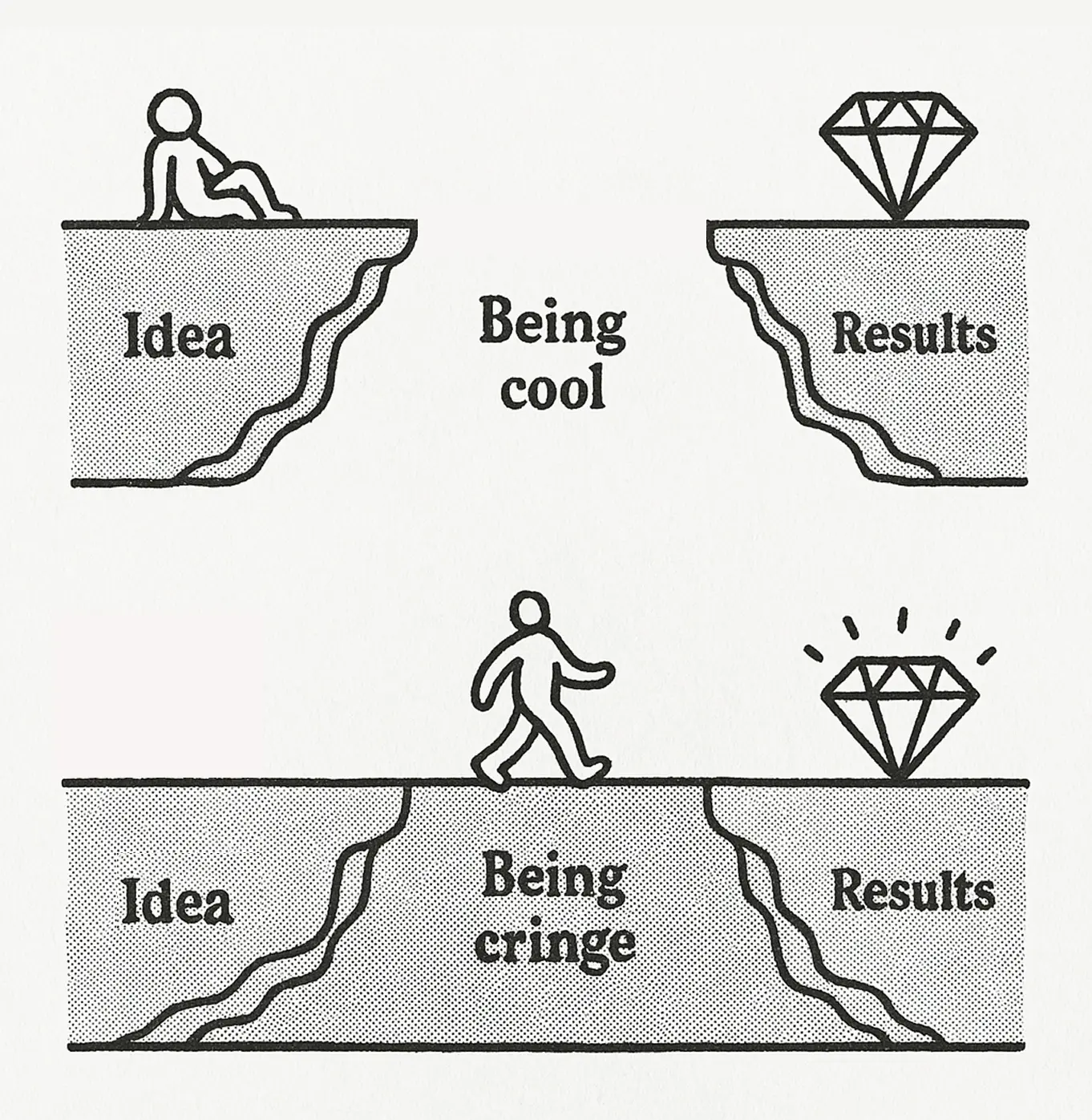
On existential cringe as a personal/professional motivator
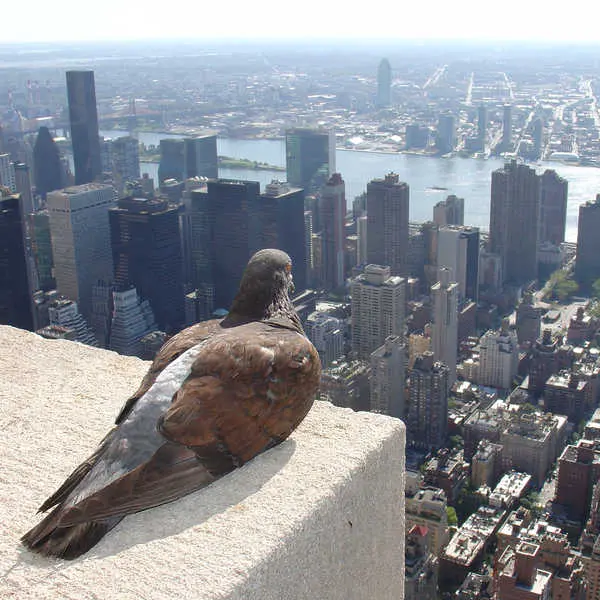
There are many signs that middle age is creeping, or has crept, up on you. One is that you start putting your foot up on a chair or something else to put your socks on. Another is that you start showing an interest in birds.
My mother has always been interested in what Jenny Odell, author of How to Do Nothing would call "bioregionalism" - i.e. which birds and plants inhabit a particular area. Usually, for my mother, it was her garden in the place that my parents have lived for 40+ years.
One thing I have learned about attention is that certain forms of it are contagious. When you spend enough time with someone who pays close attention to something (if you were hanging out with me, it would be birds), you inevitably start to pay attention to some of the same things. I’ve also learned that patterns of attention—what we choose to notice and what we do not—are how we render reality for ourselves, and thus have a direct bearing on what we feel is possible at any given time. These aspects, taken together, suggest to me the revolutionary potential of taking back our attention. To capitalist logic, which thrives on myopia and dissatisfaction, there may indeed be something dangerous about something as pedestrian as doing nothing: escaping laterally toward each other, we might just find that everything we wanted is already here.
– Jenny Odell, How to Do Nothing
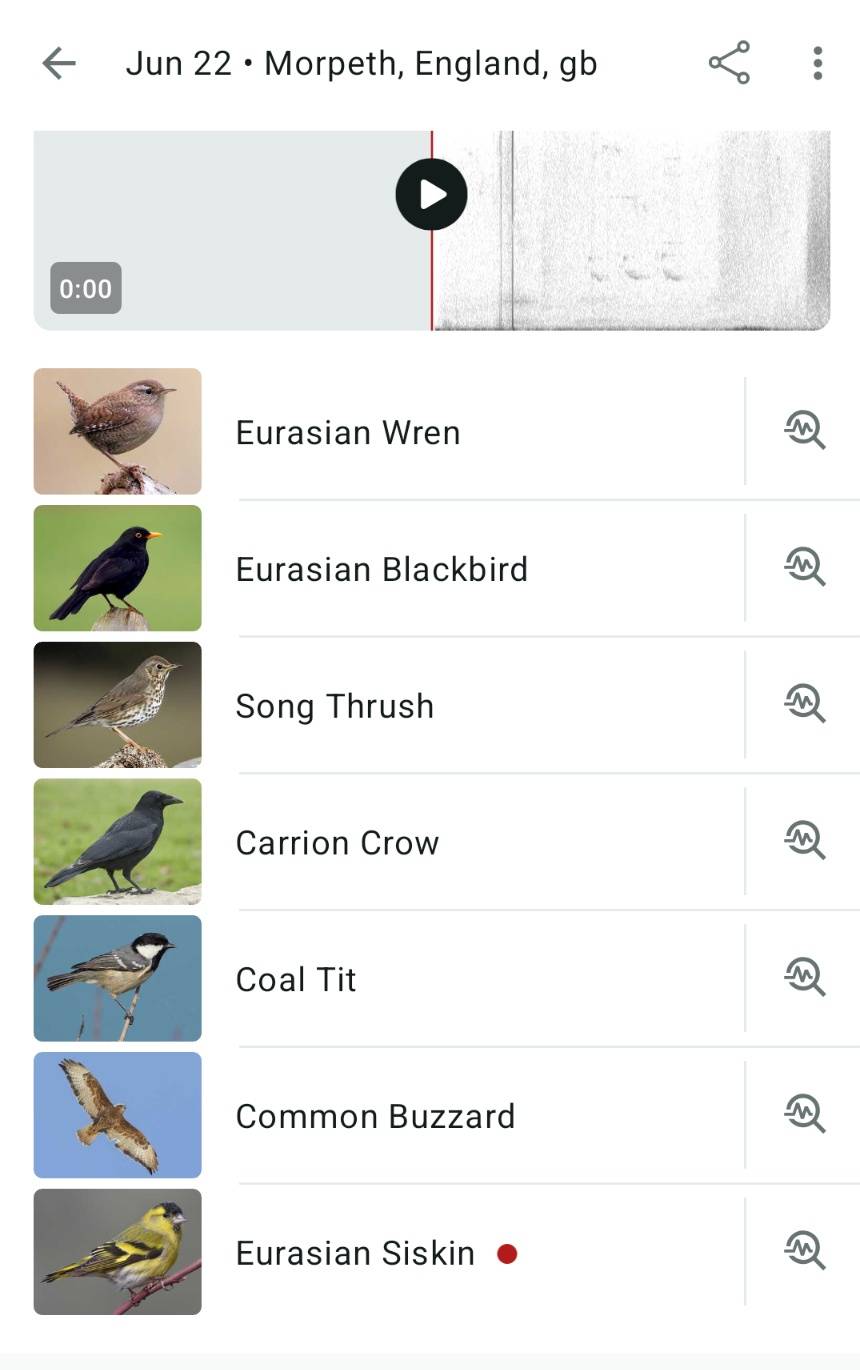
When I lived with my parents, my mother would take me around their garden and tell me (and sometimes test me on!) the names of plants. More recently, since she's been retired, she has shown an even greater interest in birds. So she was delighted when I shared with her the Merlin Bird ID app. It feels like magic: you just let the app have access to your microphone and location, and it identifies the birds that are vocalising in your immediate area.
I'm not going to lie: there's something a bit "trainspotter" about admitting to enjoying identifying birds. It's a bit cringe. But, hey, today I'm exactly 45.5 and that makes me not only middle-aged but cringey by default. So I fired up the app, and... how cool is this?
Looking back, as I grew up in a reasonably tough, somewhat deprived ex-mining area, I spent most of my teenage years navigating being interested in philosophy with also trying to appear to be "one of the lads". As such, avoiding being cringe was Priority #1. This approach became hard-coded to such an extent that it has affected my parenting of my own children: I didn't want them to be cringe.
But there's something extremely constraining about being concerned about what other people think about you. It's not until I underwent some CBT in 2019-20 that my therapist gave me permission to 'remove my mask'. After recent conversations, I'm not sure what the balance is between feeling "not good enough" and some form of neurodiversity. But, either way, wearing any form of mask in a vain attempt to avoid being "cringe" is not exactly a healthy way to live.
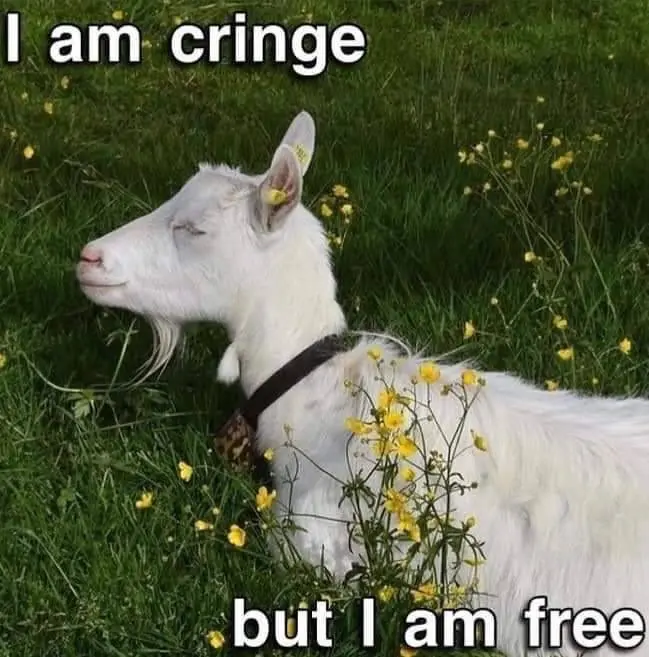
Because ideas and fashions change over time, it's inevitable that things we think are normal, or even cool now will become "cringe" in future. It's just the way of the world. So you might as well lean into the cringe if it can be creatively unlocking and a way to reach your personal and/or professional potential. As Cate Hall writes:
Each of us has a sensitive spot, a core fear or discomfort that we see as more hurtful than everything else. We relate to it as an existential peril and do everything we can to shove it far away from us. Perhaps on a rational level, we know that it’s not an existential threat — it’s just another feeling. And we’re probably already feeling it: by avoiding it all the time, paradoxically, we keep it ever-present in our consciousness, in a watered-down form. Somehow, ingesting this feeling at low concentration for our entire lives does not kill us.
Nevertheless, we try not to confront the feeling directly. Even considering the feeling creates an existential cringe reaction, an instinctive repulsion. As Bruce Tift says: “Almost all of us have a sense of annihilatory panic associated with our core vulnerabilities. This is an intense sense of threat, impossible to really put into words — ‘If I have to feel this feeling, I will cease to exist.’” Any path in life that involves such a confrontation lies on the other side of a cringe minefield, a barrier created by the promise of that feeling.
This influences, to an astonishing degree, what we do with our lives. Perhaps you fear loneliness and monotony. Cool — you take a highly social job with lots of choice and few long-term restrictions, like being a fine dining waiter or a wedding planner, so you rarely have to be alone, and you can always walk away from a particular workplace. Perhaps you fear being seen as worthless — so you chase prestige, and find yourself coincidentally interested in occupations valued by your society, with friends who also have high-status jobs, and you try to be just a little more impressive than they are.
And that’s all fine. In a sense, this is just working with the gifts you were given, playing the cards you were dealt. But relying too much on your natural gifts, in order to avoid the existential cringe, is hugely limiting. Cringe fields are where our biggest self-improvement gains are likely to come from, because they point to parts of the self we haven't allowed to develop — there's only so much you can continue to squeeze out of your core strengths, but you can get noob gains from focusing on your core fears. This means that existential cringe is actually a signal pointing you to where you can make the most progress quickly.
– Cate Hall, 'Crossing the cringe minefield'
Although there's much in life that we do choose and much more that we could choose if we realised how much agency we have, there's also plenty that we are not in control of. We happen to have been born at a particular time and a particular place, to parents and of a line of ancestors not of our choosing. We don't choose many of the things that happen to us, and we don't (usually) choose afflictions such as chronic illnesses that make us weaker.
Someone like me or you, with our looks, talents, and dispositions, might have absolutely flourished in another time period. And I don't mean '500 years' ago; I mean even just being born 10 years earlier. But who is to say what 'flourishing' looks like anyway? Who actually stands in the way of our ability to define our lives as successful, unsuccessful, cool, or cringe? It's quite likely that, no matter what our efforts are, some people will love us, some people will hate us, and most people won't even think twice about us.
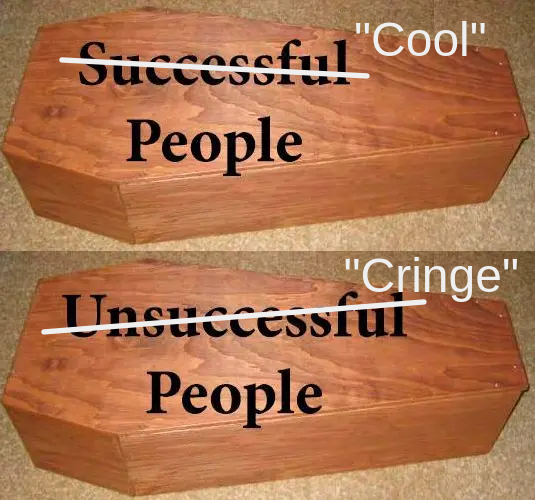
I'm not unfond of quoting Epictetus in this kind of situation. And surely Stoicism has (re-)jumped the shark by now, so it's an appropriate addition to this note:
Some things are in our control and others not. Things in our control are opinion, pursuit, desire, aversion, and, in a word, whatever are our own actions. Things not in our control are body, property, reputation, command, and, in one word, whatever are not our own actions.
[...]
Work, therefore to be able to say to every harsh appearance, "You are but an appearance, and not absolutely the thing you appear to be." And then examine it by those rules which you have, and first, and chiefly, by this: whether it concerns the things which are in our own control, or those which are not; and, if it concerns anything not in our control, be prepared to say that it is nothing to you.
– Epictetus, The Enchiridion
So if you'll excuse me, I'm off to nurture my collection of gifs, watch this ContraPoints video, and finally cross the chasm: