
AuDHD & interest-based neurology
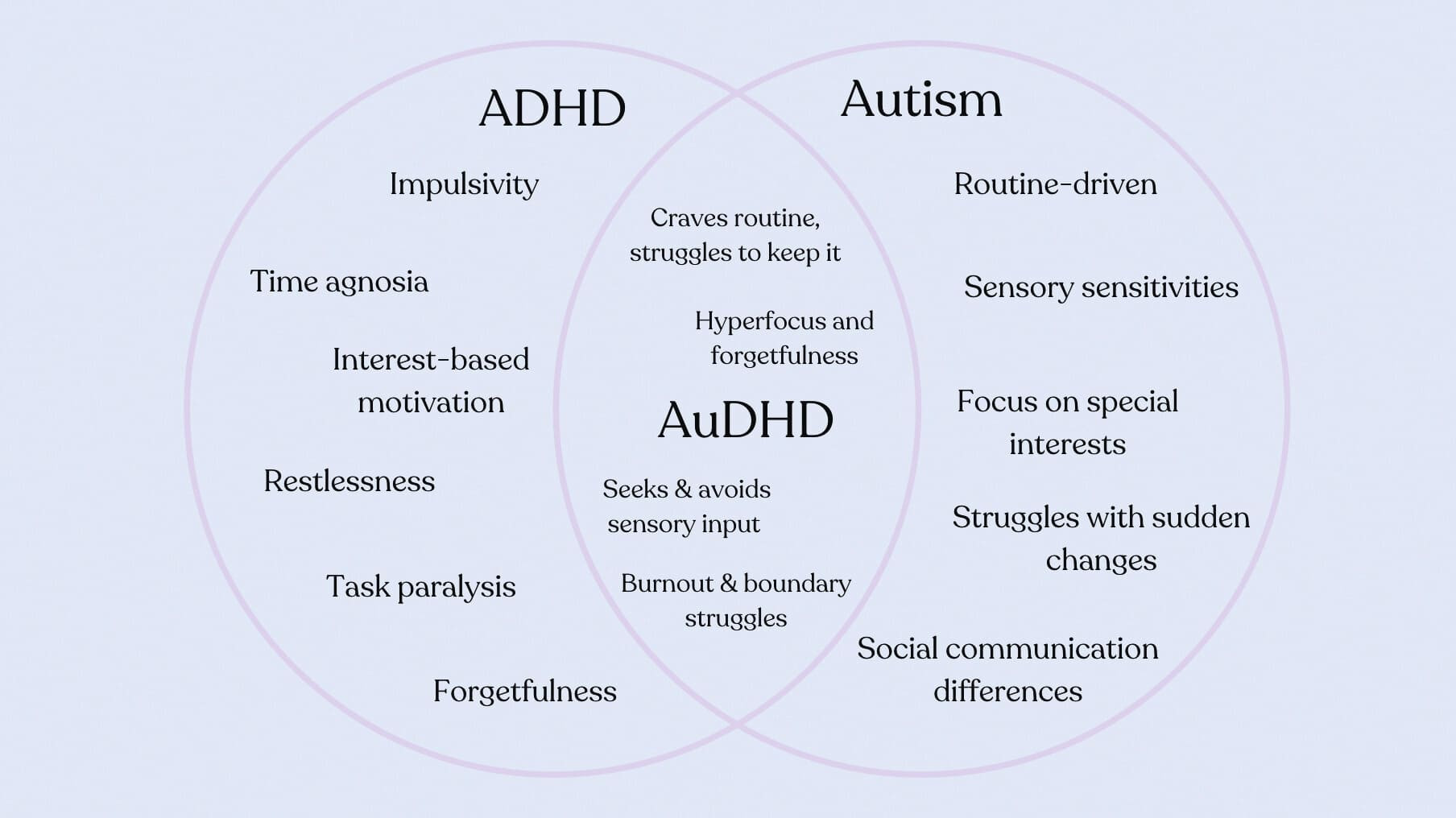
On Friday, I had the immense pleasure of reconnecting with a friend I haven't spoken to for over a decade. I'm not sure why, other than we used to live near each other, and then we didn't. Life gets in the way, sometimes.
We talked about many things, but one of the main topics of conversation was their AuDHD (Autism + ADHD) diagnosis:
People with AuDHD may wish to understand their autistic traits, their ADHD traits, and the issues brought about by the combination of the two. Each overlapping symptom alters the manifestation of another, creating an entirely new condition beyond ‘just ADHD’ or ‘just autism’. Sometimes the combination is ideal, for example, the risk-taking behaviour of ADHD is balanced by an autistic person’s cautious nature of staying within their comfort zone. The autism prevents the ADHD risk-taking from leading to potentially dangerous outcomes, and the cautious nature of autism can be challenged by encouraging the expression of spontaneity by the ADHD brain. Sadiq suggests that people with AuDHD are constantly balancing the need for stability with the desire for change. These opposing choices are not considered either/or: individuals with AuDHD need both of these things at different times and in different contexts. Learning to live on this see-saw clearly takes time, insight, and compassion.
Listening to them talk about their experiences and how AuDHD manifests in their life connected to another conversation I'd had recently with an ADHDer who described their autism as the "city" and their ADHD as the "weather".
I recognised many things they were both talking about in myself, to be honest.
Compounding the experience is the feeling many autistic people have that it isn’t “normal” to feel this way and that they must camouflage their discomfort to fit in with the pack. This “masking”, as it’s known, is exhausting, invalidating and can lead to burnout.
When autism meets ADHD, it’s a curious form of alchemy, according to those who have both.
Sometimes the conditions are in conflict; at other times they’re symbiotic. There is no such thing as a perfect 50/50 split... and the brain is often “seesawing” between both conditions. This makes the presentation of AuDHD a distinctive condition in its own right, “completely different from pure ADHD or pure ASD”, he adds.
[...]
Creativity is cited as the most positive AuDHD attribute by everyone I speak to, along with the subtle pairings of traits that “complement each other in a really nice way”, as Stein puts it. “ADHD gives me a love of novelty and a very creative side. And then autism allows me to focus on a topic that I’m really interested in. All of that allows me to be very self-directed.”
[...]
Other AuDHDers give colourful analogies to describe the epiphany of diagnosis. Before the discovery, I’m told, it’s as if you are trying to fit in and be a horse rather than celebrating the fact that you’re a zebra. It’s like being trapped in a maze in the dark, then suddenly the lights are on and now there’s a way to navigate out.
There's plenty of stigma around neurodivergence, of course, but there's a couple of insights from someone quoted in a blog post on Richard Murphy's blog which might help reframe that. The first:
The reality of life for a person with any of these conditions is that they have to become an acute observer of what is regarded as “normal behaviour” and learn by observation what it is so that they can comply with it, which is the demand that neurotypical people make of those with ASD, ADHD and AuDHD.
In other words, the non-neurotypical person becomes more aware of what it is to be neurotypical than neurotypicals themselves know, precisely because they have spent so long studying it that you can imitate it to perfection, even though it is something tney will never be.
And the second:
[T]hese are not diagnoses as such. They are, more properly, discoveries.
After all, these conditions are not a sickness, but are instead descriptions of the difficulties people have fitting into a world that does not wish to accept the way non-neurotypical people are.
The reality is that life with these conditions can be great. There is absolutely no reason why not. In fact, those with them often bring what might be called superpowers with them, which can be liberating and enormously valuable to society.
For example, the reason why so many people with one or both of these conditions are so creative is that they have to develop deep insights because they have to observe the world acutely, and therefore understand its peculiarities, which they can highlight in their work as both participants and observers.
There is also a very good reason why so many comedians have one or more of these conditions, and that is that they can, in particular, see what is so funny about so much behaviour because, once again, they have to observe it so closely.
Murphy himself does not have an AuDHD diagnosis, but strongly suggests that he fits the criteria. He talks about being an INTJ, like me, and drawn to systems thinking; and, in another post, talks in another post about being "profoundly introverted in the Jungian sense" meaning that his career was "always going to be struggle, no matter how successful he appeared to be.
Others, he says, can't understand – and almost won't allow him to label himself as an introvert - or, indeed, AuDHD:
If I go back to the incomprehension people suggest they have about my being an introvert, this is frequently stated as an outright contradiction. They say, “No, you're not”. I would hope these days that no one would say “No, you're not” if someone imparted that they thought themselves gay, lesbian, bi, queer or trans. But apparently, it remains quite acceptable to say to someone they are not an introvert, or not AuDHD, or whatever else they might know themselves to be, denying their whole lived existence as a result. And yes, I am angry that this is apparently acceptable in our society.
I have more to investigate in this area...
Image: BFF Clinic