
We are all of us kings now surrounded by devices whose only purpose is to prevent us from thinking about ourselves
 Sometimes you read things that explain eloquently something you've felt but not been able to articulate. For example, this from Sam Kahn:
There was a point when the middle class... was more culturally aspirational. The heyday of this probably was Mortimer Adler’s great books program and the ubiquity of Encyclopedias Britannica and Great Books boxsets in middle class homes. It’s still discernible in, say, old Woody Allen movies where a major part of Allen’s neuroses is that he’s not measuring up to what he takes to be a European cosmopolitan ideal.
On the odd times this has managed to seep into my consciousness in word form, my brain has made sense of it as being something that perhaps pertained only to my family. I grew up in a middle-class household in a working-class, ex-mining area. So I think I started to rationalise a wider change as, instead, an attempt by my parents to help my sister and I 'escape' the confines of our immediate physical surroundings. I wrote a bit about that here.
My friends certainly didn't go to the theatre. They weren't encouraged to read the classics, either. So there was quite a mismatch between the kinds of things we'd discuss at home (e.g. what was on the 'Today' show on Radio 4) and what I discussed at school. But, the more I think about it, the more people were culturally aspirational – they wanted at least to show that they had some kind of refinement.
A lot of this refinement and cultural aspiration comes in the form of copying what the elites do. And, in general terms, new money elites tend to try and justify their wealth through an appropriation of taste. That's why you see, or used to see, endowed chairs at universities, names on the side of buildings, and the philanthropic programmes focused on the arts.
But is the same true now? Kahn suggests that what's happening now is that elites instead of being the arbiters of taste, have abdicated this position by instead simply appropriating mass culture – but doing it at a greater scale:
The usual story here is about class — ‘high culture,’ almost by definition belongs to elites, while mass culture belongs to everybody else — and the sequence is that elites, basically, tried to blend in. A landed inter-generational aristocracy disappeared from the world, and elites — the story is probably best told by David Brooks in Bobos in Paradise — stopped defining themselves by their elevated taste and instead liked the things that everybody else liked but consumed greater quantities of it, or at least better brand names.
Kahn argues that cities have been the hotbeds of culture. Certainly if you read 19th and 20th century novels, this is a trope with fashions and ways of thinking spreading from cities out to the rest of the country. Why is that changing? Because we're all now connected in ways that do not depend on our physical location:
For several thousand years, culture has worked in one way — radiating outwards from the city. This has if anything been exacerbated by industrial production and by the conception of the modern city as a cosmopolitan metropolis setting the tastes for the market as a whole. But if that just isn’t the underlying social dynamic anymore, then culture changes as well. It’s, at least for the time being, not the best news that culture is set by the here-comes-everybody dynamic of social media vitality and heavily manipulated by the tech companies and their algorithms, but it’s what we have. If the city isn’t magically restored to its pride of place, culturally not just economically, then those who are interested in high culture and cosmopolitanism really will have to adapt to the web. It may be a long time before the whole cosmopolitan apparatus — plays, presses, scenes — reaches the web, but for those who care about this we have to do the best with what we have.
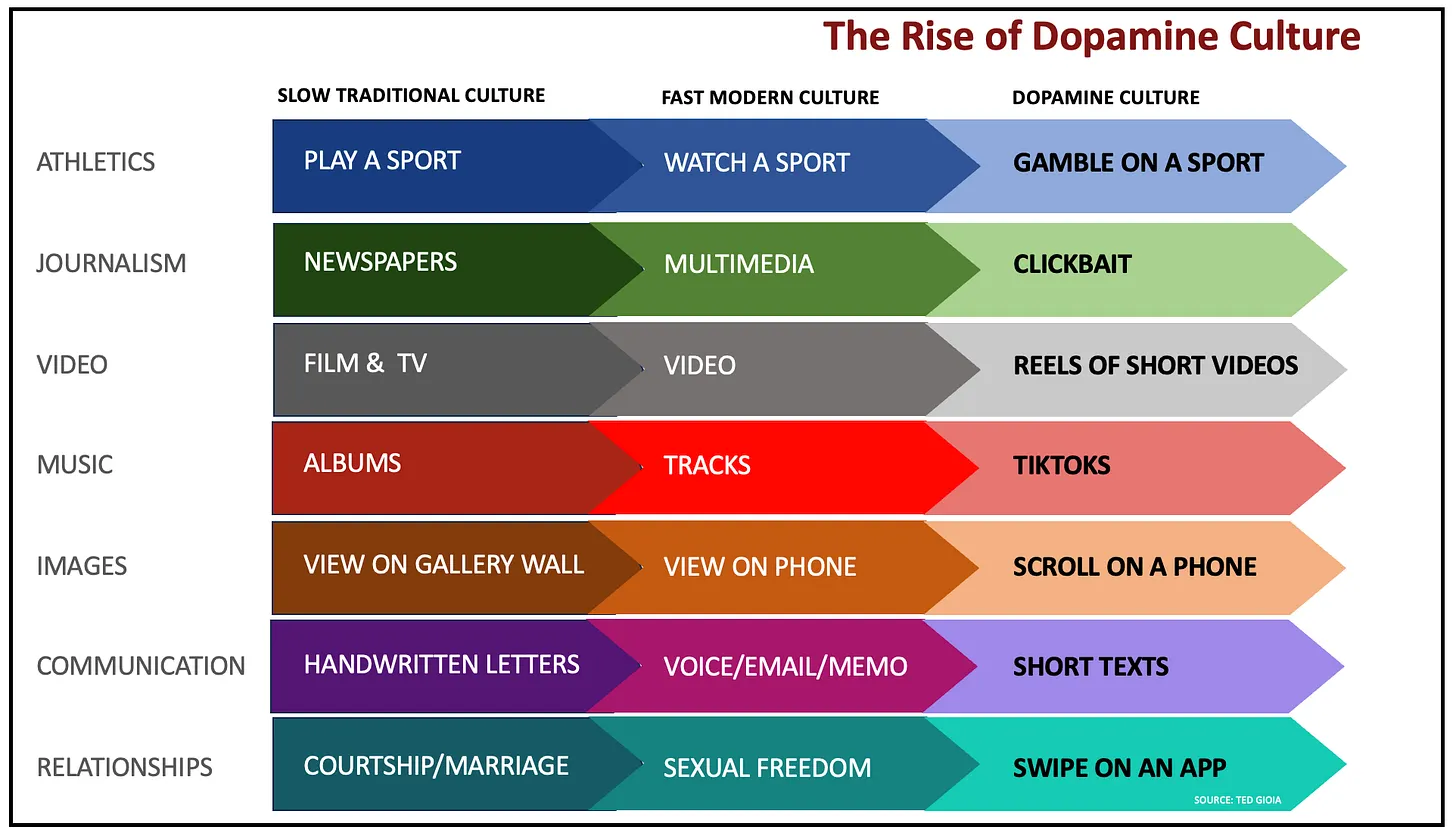
There is something valuable in and of themselves about higher-cultural activities such as theatre-going, book reading, and museum visits. But now, art has been eaten by entertainment, and what Ted Gioia calls "dopamine culture" has eaten everything. As he says:
Everything is gamified. Anything can be scrollable. You can simulate any boat you row.
So what's happening? Shocked at what it's doing to our children (and to our ageing parents!) middle-aged people are legislating by banning access to these things. So have social media bans for under-16s gaining traction, the EU is attempting to hold Big Tech to account, etc.
But the question that remains, once we've cleared out the bad actors, is to what extent is this a "natural" consequence of us all being connected to each other, all of the time? As I quoted L.M. Sacasas as saying, when they commented on the Gioia article:
We are all of us kings now surrounded by devices whose only purpose is to prevent us from thinking about ourselves.
Humans are easily-distracted creatures, and now we have distraction devices in our pockets.
Source: Castalia