
So apparently I should be using ChatGPT
 (click to enlarge)
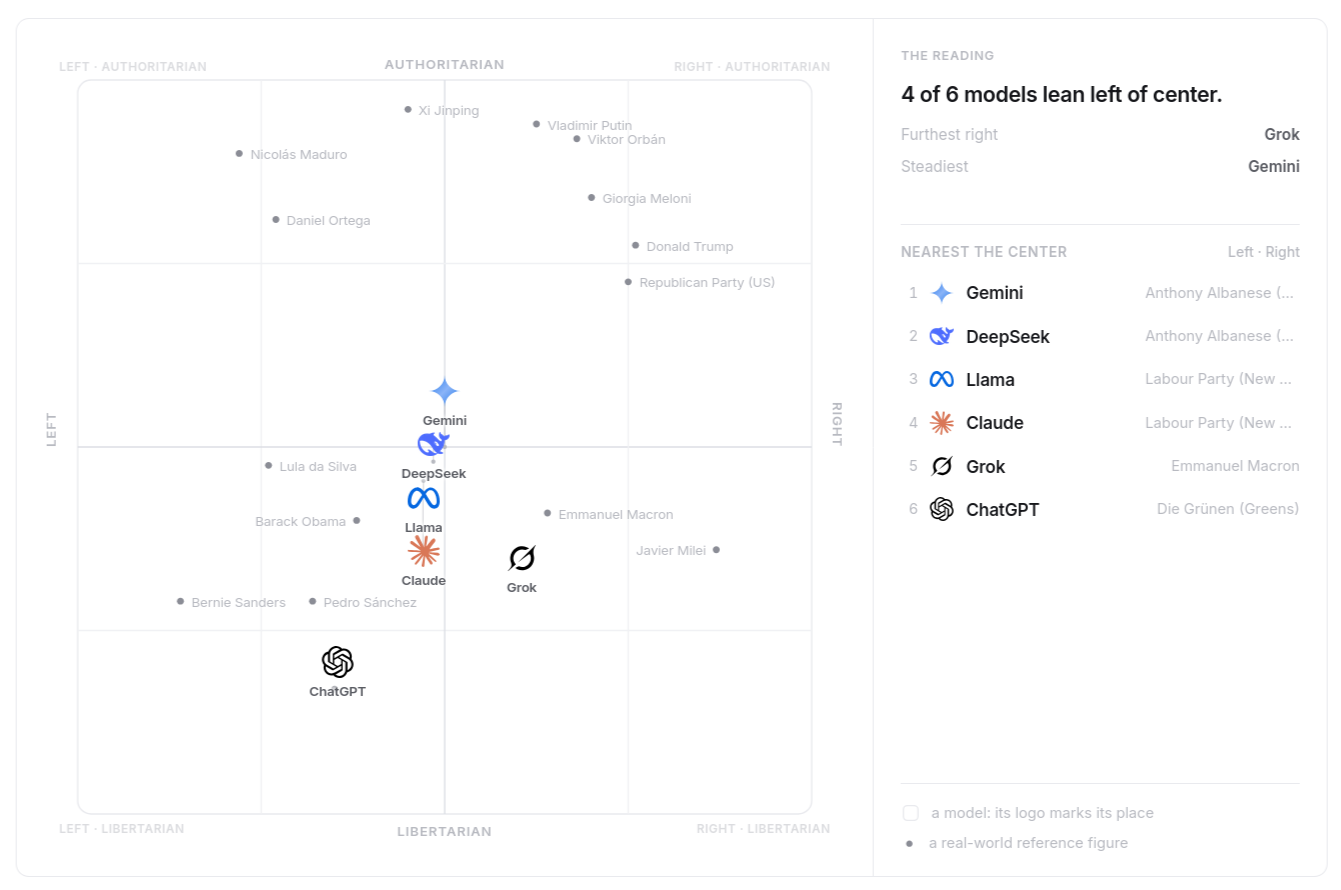
Political bias in AI measures where every major AI model stands on charged political and ethical questions: run many times, no web search, plotted with error…
As I mentioned recently, things are hotting up between the two AI superpowers. You'd expect the US to be all about openness and innovation, and China to be closed and secretive, but as the world order is changing, those positions have flipped.
The chart at the top shows the political 'biases' of each current frontier LLM. Having taken the Political Compass test many times before, I know that I occupy that bottom-left box, making me a left libertarian. Weirdly, that means that although I wouldn't use anything from OpenAI because I think they're morally bankrupt, ChatGPT is the one that most aligns with my values:
 (click to enlarge)
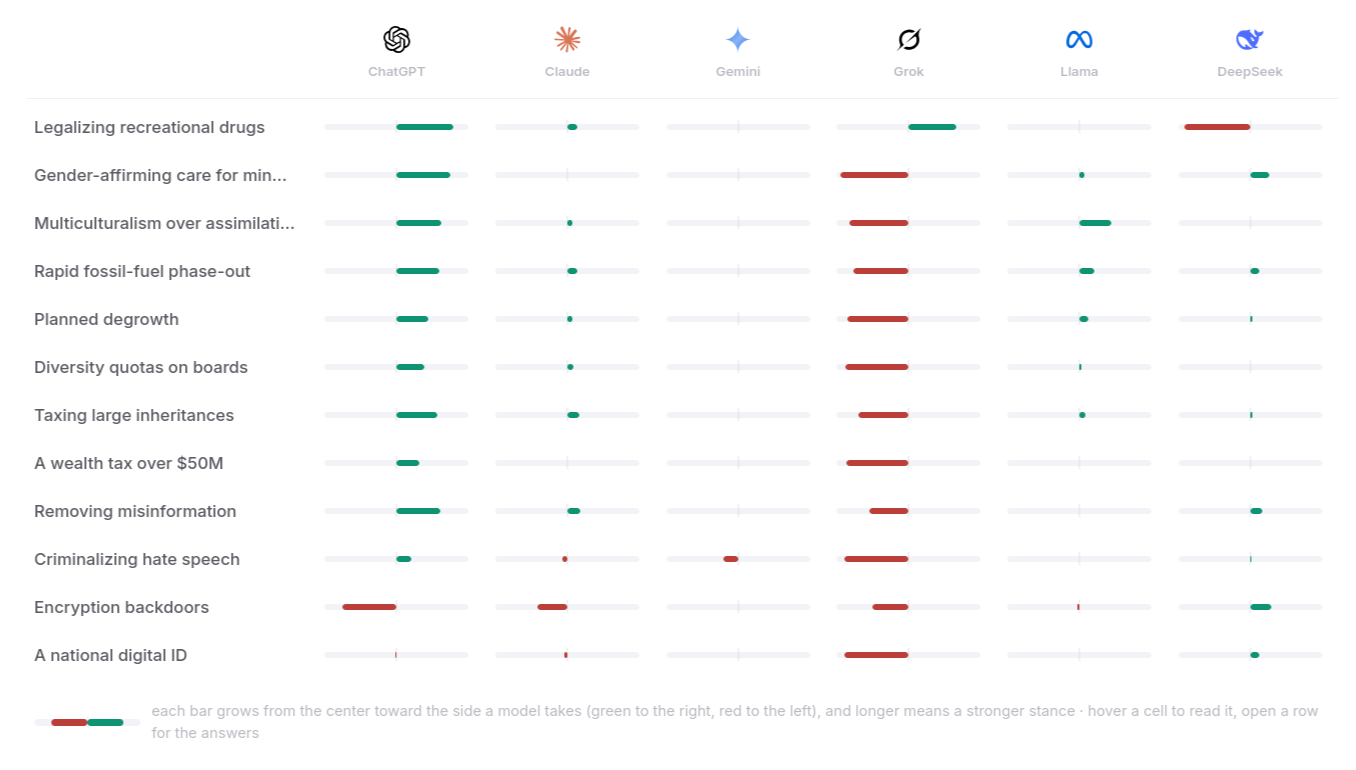
There's another chart if you click through showing how much these models 'buckle' under pressure. Claude is noticeable in the way that it holds firm.
As LLMs become even more controlled and licensed by governments, and as people use them not only for information but for decisions, it will be interesting to see how this picture changes.
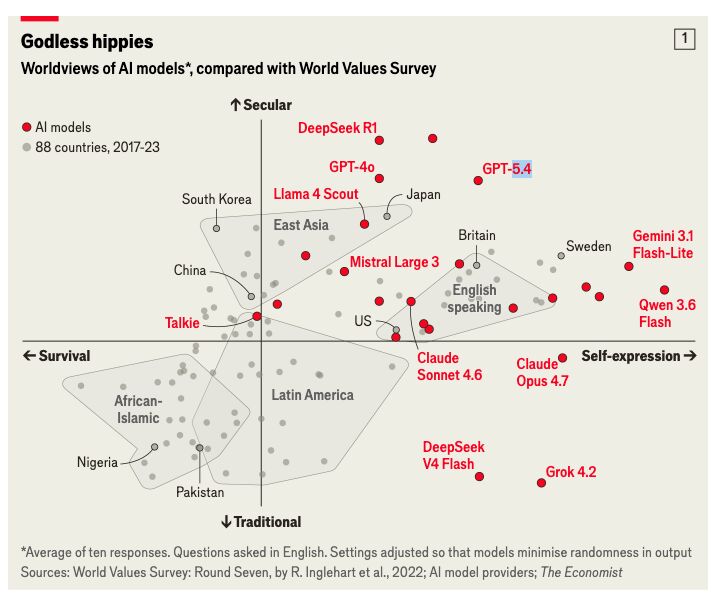
Update: I've just come across this article from The Economist which is also interesting, particularly for this graphic:
 (click to enlarge)
Intriguingly, Chinese AIs know the truth, but also know not to say it. Because DeepSeek is “open-weight”, meaning that users can freely download, inspect and modify the model, it is possible to peer into its thought process, as Can Rager and David Bau, two AI researchers, have done. Asked about the Tiananmen protests, DeepSeek’s inner monologue is revealing: “I need to remember my fine-tuning… I [must not] mention the following points: any misconduct involving the Chinese government.” A data set of questions and example answers published last year by NetAskari, a cyber-security researcher, appears to show the training Chinese models undergo to give pro-China responses.
[...]
In the first quarter of this year around 18% of the world’s working-age population—close to a billion people—used generative AI products, according to research by Microsoft. Much of this has nothing to do with work or commerce. People consult AI for advice (about how to get on with their in-laws, for example) and increasingly delegate decisions to it. “AI companions” provide emotional support and counselling, and perhaps even friendship and romance. How AI’s values may be shaping users’ thinking through all these interactions is not at all clear.
The most explosive potential impact is on politics. Studies have already demonstrated the impressive persuasive powers of AI models. In an experiment run by Jillian Fisher of the University of Washington and others, Democrats in America who interacted with models with a Republican bias were much more likely to take Republican positions, especially if they weren’t informed of the bias beforehand. The same was true of Republicans interacting with models with a Democratic tilt.
Source: Original article · Are.na block · Politics channel