Major updates from Bonfire

Earlier today, I received a message from Ivan Minutillo, one of the core team behind Bonfire. He knows that I've got at least one client interested in Bonfire, but also we used to work together on MoodleNet, so he keeps me up-to-date with anything I might have missed.
The Bonfire team has been busy! Not only have they got a lovely redesigned home page, but they've created a case study of work they've done with Jacobin.de on a new social site. The place to go for all of the links is this social post, and the excerpt below is from their Bonfire x community announcement:
When Bonfire Social reached 1.0 in November last year, it delivered a polished, locally-governed, federated social app where people control their feeds, their boundaries, and who can reach them. Some spaces may stick to that (with individuals following each other and sharing not much more than a server), and we'll keep maintaining it for them.
But social was step one of a longer plan. While open source tools for decision making, events, or mutual aid have existed for years, they struggle because they sit apart from where people like to talk. Built into a social space instead, alongside the people you already follow, your groups and your feeds, the same tools gain the everyday pull that keeps communities on the big platforms. And those relationships belong to you: every tool shares them, and they travel with you across the open web.
A year with real communities confirmed it. Nobody came to us asking for a better microblog. They came wanting to give their community a home. A magazine whose readers wanted to debate each other, not just the articles. A mental health network that needed spaces where people could speak safely. A town that wanted its events, its announcements, and its discussions in a place that's locally governed. In every case the feed was the least interesting part of the answer.
 I drafted something about decision-making in the world of AI today for FIELD STATION which should go live later this week. It's always been a crucial thing to consider for all kinds of organisations, and I'd say it's more important than ever. That's why I'm particularly interested in that part of the new Bonfire offering:
Deciding things together is a first-class feature. Bonfire for communities ships with decision-making tools that range from quick polls to structured consensus processes, so groups can use the lightest process that fits the decision:
- Single or multiple choice: familiar polls where voters simply pick one or more options.
- Proposal and consensus, for decisions that need discussion before a vote, drawing on sociocratic practice: collect proposals, discuss and amend, integrate objections, then move forward.
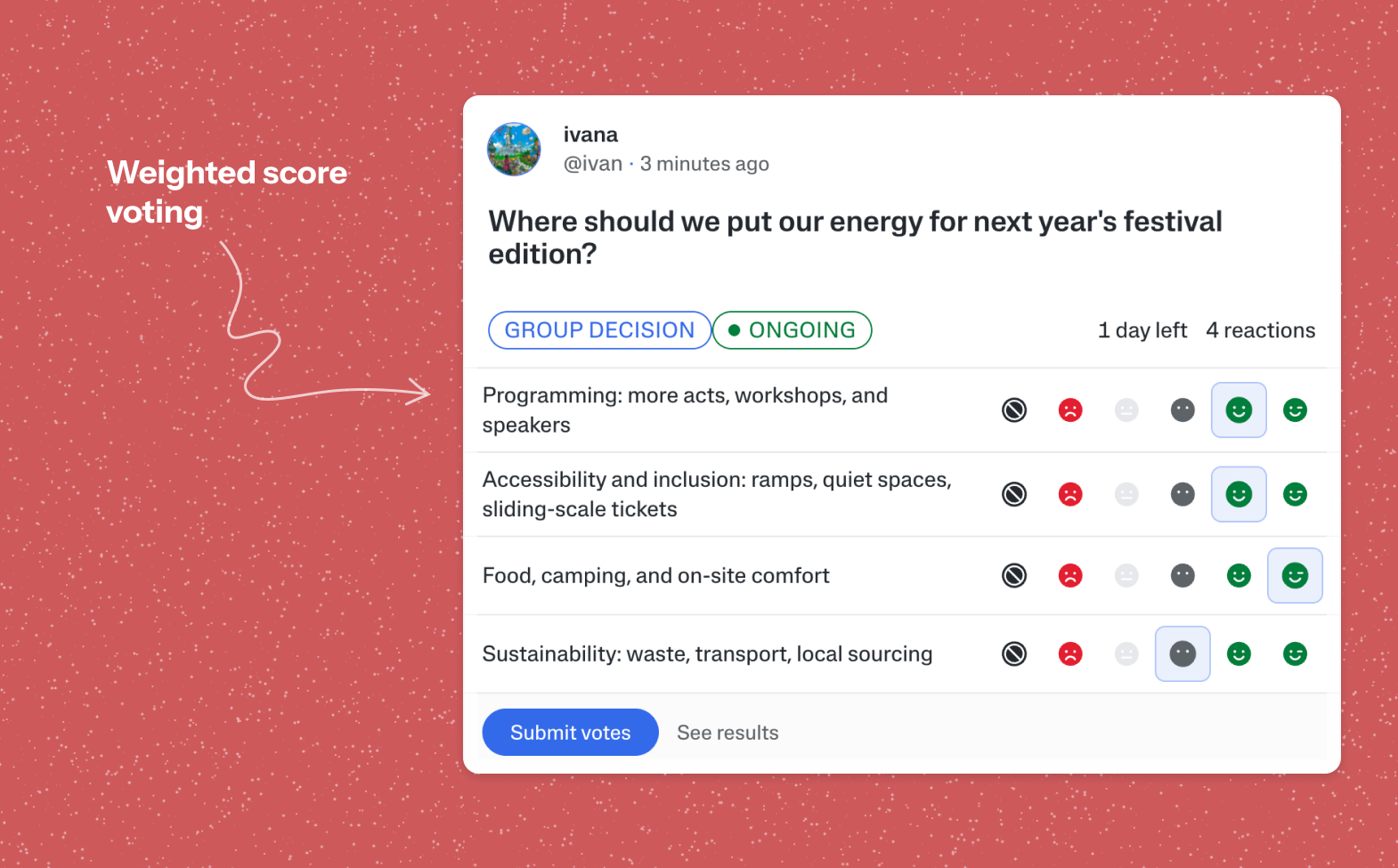
- Weighted score voting: voters rate each option rather than picking just one, and objections can optionally count more than approvals (up to outright blocking or veto), so the choice with the strongest support and least resistance wins.
The design draws on sociocratic practice and on tools like Ukuvota and Loomio. Polls federate as ActivityPub
Questionpolls, so people on Mastodon and elsewhere can also take part.
What I love about all this is that, increasingly, people are realising that they are making political decisions when they make technology decisions. It's something that Tom and I have been talking about through TechFreedom, and it's great to see it highlighted here:
Choosing Bonfire wasn't just a technical decision, it was a fundamentally political one. We wanted a platform that couldn't be switched off by a foreign government or bought out by a billionaire. That's exactly what we got: Bonfire built not simply for us, but with us, and the result belongs to our readers as much as it does to us.
— Magdalena Berger, Jacobin DE
Enjoyed this? Get new notes by email
A digest of new notes, daily, weekly or monthly. Confirm by email, unsubscribe any time. Prefer a feed reader? Subscribe via RSS.
Around this note
Shares soil with
Suggested by AI from similar content