What we talk about when we talk about LLM-assisted journal articles
Yesterday, I posted about student assessment in the age of AI and here I am today deconstructing an editorial about the use of LLMs in academic journal submissions. You can take the man out of academia, but, it would seem, not the academic out of the man.
I follow plenty of academics on social networks, including Ben Williamson, who, along with his co-editors at Learning, Media and Technology have written an editorial about LLM-assisted submissions. The numbers are interesting, to say the least: five years ago they were receiving ~300 manuscripts a year, whereas last year it was ~1,300. This year they're on track for 2,000+.
While I've never been a fan of the academic publishing model, I am sympathetic. Journal editing is mostly unpaid, desk reviews take a long time, and nobody signs up to read 12 manuscripts one academic has knocked out in a year because they've just discovered ChatGPT. A lot of what they the editors say about the quality of these papers sounds familiar as well.
But... something nagged me as I read it. While the editors name bigger forces at work, such as publish-or-perish and the parlous state of commercial publishing, they then seemingly put them to one side! Almost every remedy they suggest lands on individual authors. It feels like "punching down" or victim-blaming.
So I had a bit of a chat with my little robot friend, and co-created a causal loop diagram based on the editorial:
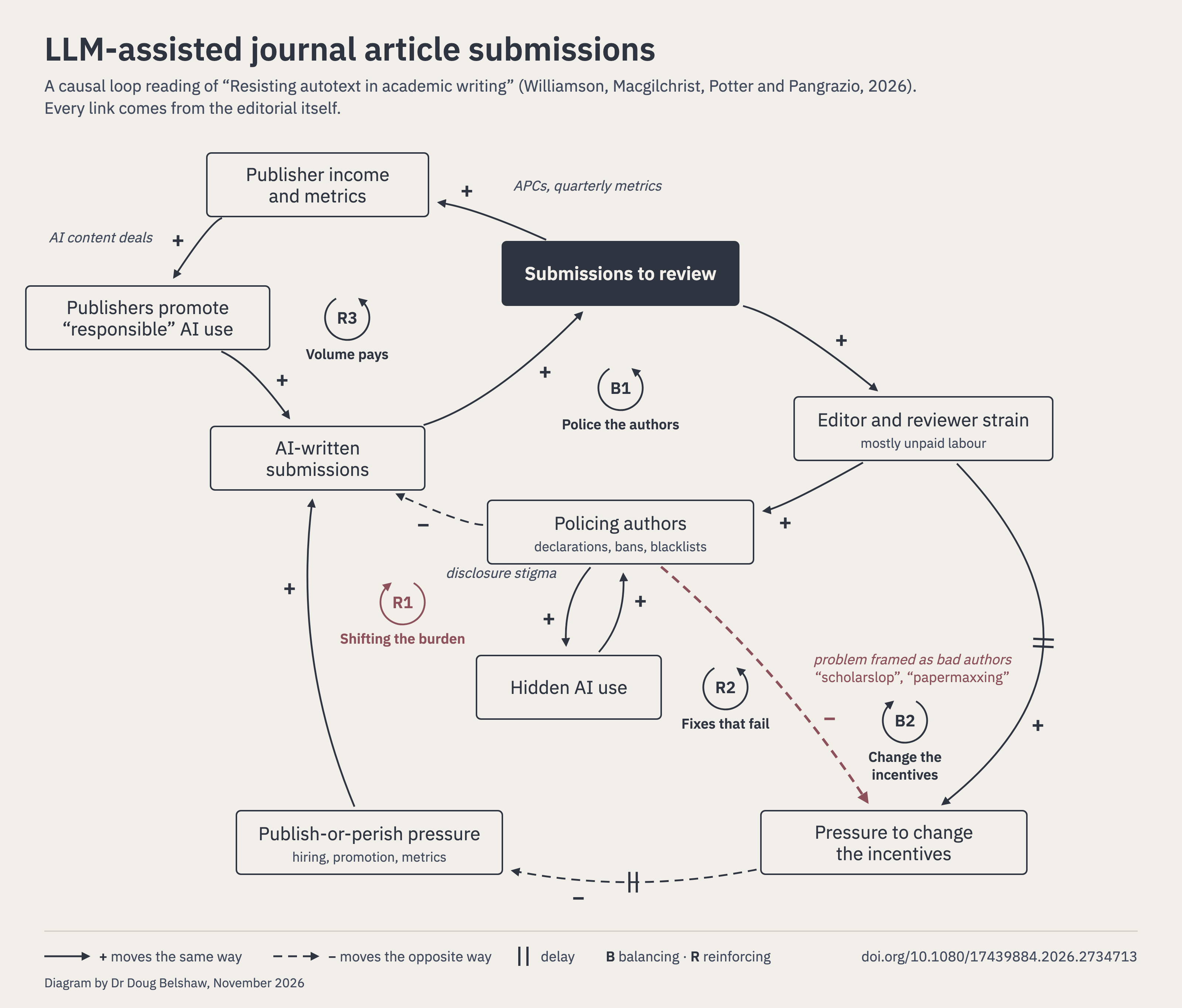
As you can see, there are five loops identified here, two of which match well-known system archetypes. For those not used to reading these, a solid arrow with a plus means two things move in the same direction. A dashed arrow with a minus means they move in opposite directions, and a double line marks a delay.
Loops can be reinforcing (R1, etc.) or balancing (B1, etc.) depending on whether they reinforce and make the problem grow larger, or whether the situation stays relatively stable.
Quick fixes
Given the current system, more AI-written (or assisted) submissions cause more work for editors and reviewers. That leads to a strain on resources such as time, which in turns results to policing: AI declarations, bans, and blacklists. Policing should cut the number of AI-written submissions. This is represented by B1, a balancing loop, and it's the main thrust of the editorial.
There's also a second balancing loop, B2. The same strain on editors could build pressure to change what drives all this AI-assisted volume in the first place. That's a slower loop (hence the delay marks in the diagram) where processes around career progression aren't so tightly coupled to outputs, which means a decline in the publish-or-perish culture. No editorial board can fix this alone.
Shifting the burden
Systems thinkers will recognise the "shifting the burden" archetype represented by loop R1. Ironically enough, even if it doesn't work well, the quick fix works well enough to take some pressure off the larger, slower one.
In other words, once the problem looks like bad actors/authors there's less reason to ask why so many academics feel they have to produce so much. The incentives stay in place, and so the submissions keep coming and the editors ramp up the policing.
Then there's loop R2, which is a "fixes that fail" archetype. The editorial mentions an Oxford University Press study which found that almost half of authors think disclosing AI counts against them. So, guess what? Stricter rules end up making people less likely to disclose their AI use, which in turn leads to calls for stricter rules. 🤦♂️
Loop R3 is the one I find most interesting, though. Ben and his editor colleagues are refreshingly candid that their publisher is "very content with the increase in copy and proudly presents [them] with metrics of the journal's performance each quarter". As they point out, publishers are signing deals to share academic content with AI companies, and promoting "responsible" AI use to authors. More volume pays. So as long as that loop keeps running, editors are bailing out water from a boat that the publisher is quite happy to see filling up.
The words
That's all very interesting but the thing that actually made me want to write this post was the use of language in the editorial.
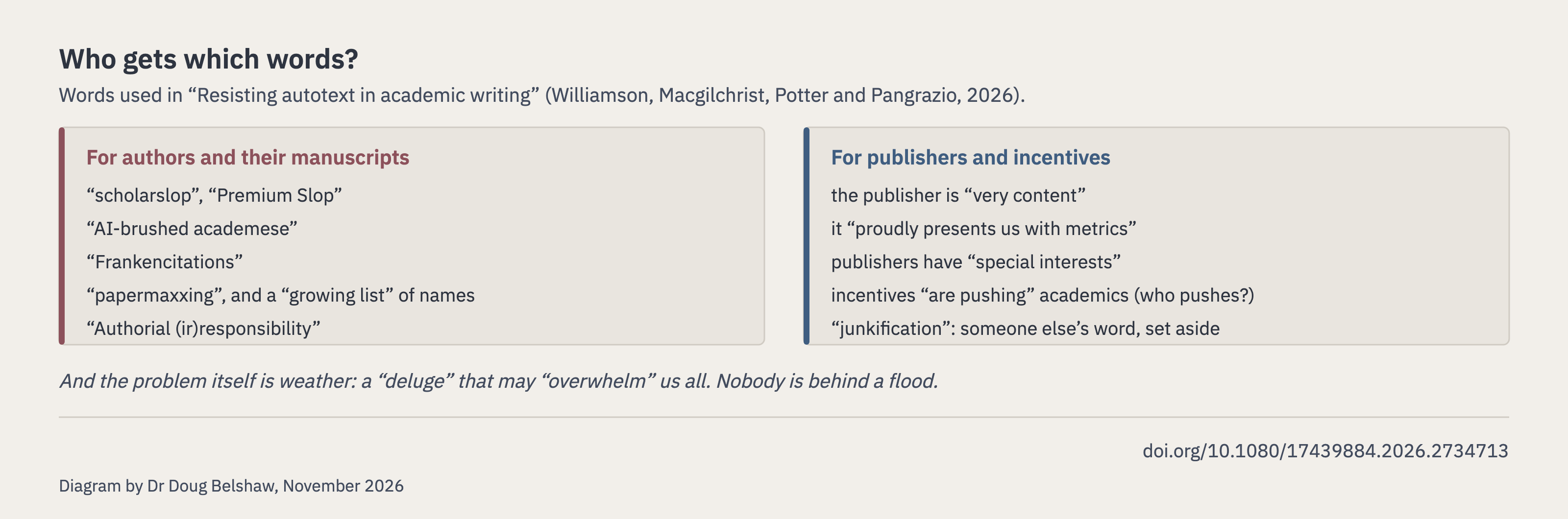
Just look at terms reserved for authors: scholarslop, papermaxxing, Frankencitations, AI-brushed academese. Meanwhile, the terms used for publishers are mild. Their interests are "special" and they're content with the growth. Publish-or-perish incentives might push academics around, but the editorial doesn't say who's doing the pushing. The word "junkification" does appear, but it's someone else's, and it gets set aside.
Then there's the water metaphor. The editorial describes a "deluge" that may overwhelm us all. A flood is something that happens to you, with nobody behind it, just the force of nature. That framing makes it harder to see who benefits from the volume.
As I'm sure they realise, this matters most for the people the editors want to protect. While they may recognise that early-career and non-Anglophone scholars face the most pressure, and get sold AI as a leg-up, those same scholars are most likely to end up on a blacklist.
To be fair
Perhaps I'm sensitive to this because I'm currently working with a charity that exists to help scholars in the Global South. But I do understand that editors have to work with the levers they have at their disposal. They can't rewrite university promotion criteria, nor stop Taylor & Francis from signing deals with AI companies. Policing authors is a lever they have available to them, whereas reforming scholarly incentives isn't. And they do call on publishers and scholarly societies to do more for marginalised scholars.
But an editorial in a widely read journal is itself a lever. It could point at the publisher and at universities as much as at authors. Here are a few things that might help:
- asking the publisher to slow or cap growth, especially given the parasitic nature of the academic publishing industry
- paying editors and reviewers (or at least recognising their work properly)
- backing efforts to stop counting outputs in hiring and promotion, such as DORA and CoARA
I was a little hesitant to post this, as I have a lot of respect for Ben and his work. He's spent years writing critically about edtech platforms and the companies behind them, and I suspect he'd agree with most of what I've written here. That's why I'd love to see the next editorial turn the same level of analysis on those who benefit from increased volume in the academic publishing industry.
Enjoyed this? Get new notes by email
A digest of new notes, daily, weekly or monthly. Confirm by email, unsubscribe any time. Prefer a feed reader? Subscribe via RSS.
Around this note
Shares soil with
Suggested by AI from similar content