The AI money loop
I'd been meaning to write about this (hence the date of the original note), but Jensen Huang resigning as Nvidia's chief executive today, effective immediately, means now's the best time to hit publish.
The BBC is running a live page, and Nvidia's own announcement is just three short paragraphs. Colette Kress, the Nvidia's CFO, is stepping up to interim CEO, and Harvey Jones becomes the company's first ever chair. Shares have fallen more than 10%.
The reasons for Huang's exit are still coming out, and that's a job I'll leave to journalists and others. What interests me is what he leaves behind, which is a web of deals in which Nvidia, in effect, pays its customers to buy its chips.
So I worked with my little robot friend to create a map.
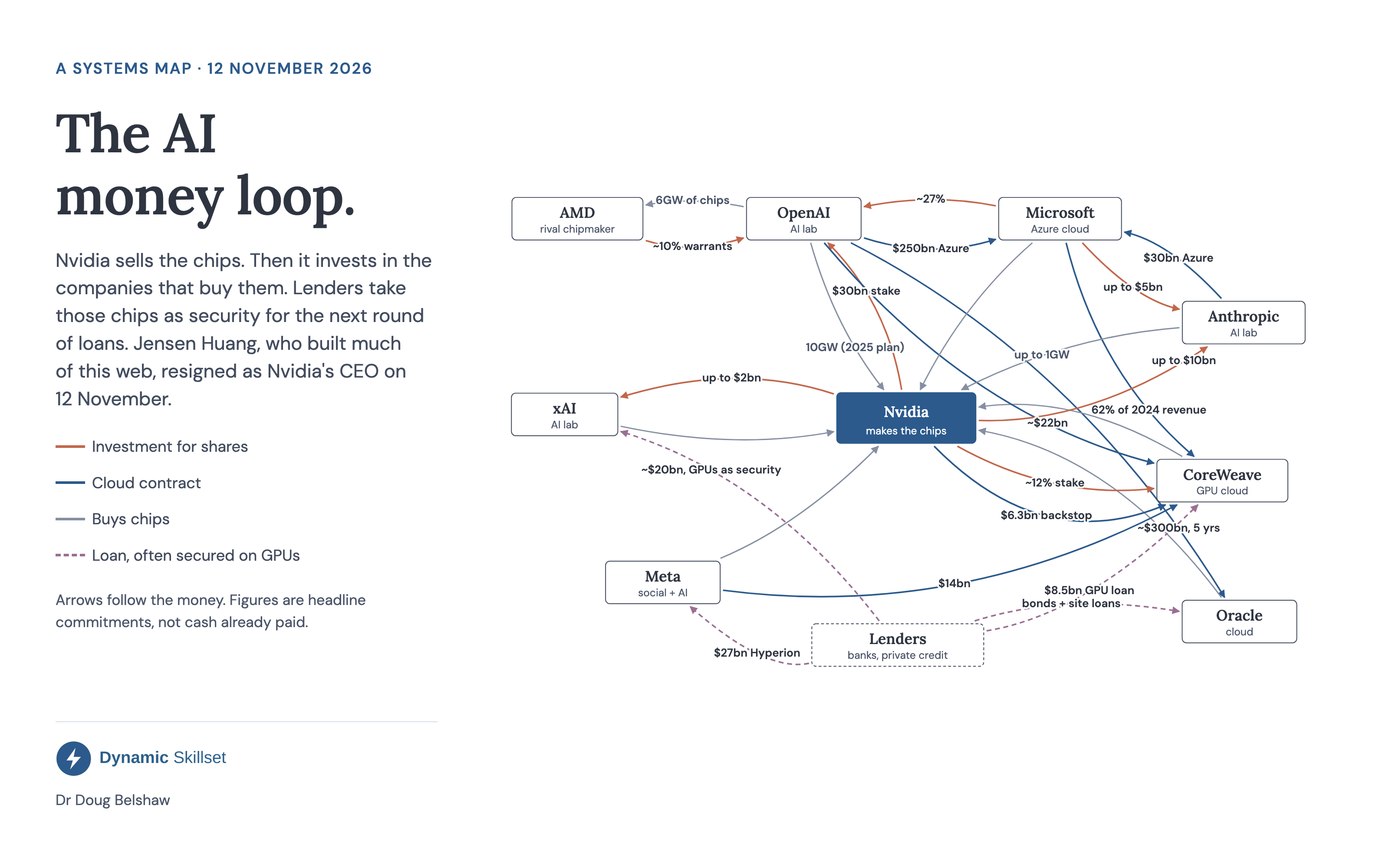
(right-click and 'open image in new tab' to see full-size)
How the loops work
If we take the simplest one, Nvidia puts about $30bn into OpenAI, and OpenAI signs a reported $300bn, five-year cloud deal with Oracle. Oracle borrows money to build the data centres and fills them with Nvidia chips. Nvidia books the sales, its share price goes up, and it has more cash to put into its customers.
In systems thinking terms, that's a reinforcing loop. That's great on the way up and brutal on the way down.
CoreWeave is the most extreme case I found. Nvidia owns more than a tenth of it, sells it GPUs, and has agreed to buy up to $6.3bn of its spare capacity if nobody else does. That means it's acting as shareholder, supplier, and safety net all for the same company. To be fair, Huang said in October that CoreWeave was improving and the backstop wasn't needed. Microsoft, OpenAI and Anthropic are tangled up in a similar way around Azure. Even AMD has joined in, handing OpenAI warrants for up to 10% of the company in return for buying its chips.
Then, of course, there's the debt. Lenders now treat GPUs as collateral, and CoreWeave borrowed $8.5bn in March against its chips and a contract with Meta. The GPUs for xAI's new data centre sit in a separate vehicle funded mostly by debt secured on the chips. Meta's Hyperion site is financed through a joint venture, so about $27bn of debt sits off Meta's balance sheet. The trouble is that a GPU may lose most of its value within a few years, whereas the loans and the buildings last much longer.
Is this actually a problem?
To be fair to Huang, he argued that these deals were about securing supply and growing the market, not propping up sales. Plenty of the numbers on my map are headline commitments rather than cash. The $100bn OpenAI letter of intent turned into $30bn, for example. Not every arrow is necessarily a problem.
But we've seen this before. In the late 1990s Lucent, Nortel and Cisco lent money to telecoms companies so they could buy their kit, and when those customers went bust the suppliers were left holding the debt. The difference this time is that Nvidia's biggest customers are cash-rich giants, and most of its money goes in as equity rather than loans. Even so, Implicator makes the same comparison, and I think it probably holds up better than Nvidia would like.
Why today matters
Huang fronted many of Nvidia's biggest deals himself. The interim CEO used to run the finances, and the board now has a chair for the first time. I'd be surprised if they didn't look again at commitments that haven't yet turned into cash. If Nvidia blinks, the companies that rely on its money will notice, and so will the lenders who rely on its chips holding their value.
I'm not making a prediction, but the system is more tightly coupled than most people realise. And the person at the centre of it has just stepped down...
Figures are headline commitments from company announcements and press reports, many of them multi-year or non-binding. The Oracle and xAI figures come from press reports rather than published contracts. This is commentary on how the deals fit together, and (obviously) not financial advice.
Enjoyed this? Get new notes by email
A digest of new notes, daily, weekly or monthly. Confirm by email, unsubscribe any time. Prefer a feed reader? Subscribe via RSS.
Around this note
Shares soil with
Suggested by AI from similar content