Who owns the North East's AI economy?
Jamie Hardesty's latest Newcastle Tech Digest is a personal essay about ambition. Tracing his journey from in a council house in Jarrow, through the years he spent fighting for incremental pay rises, he ends with a question about the whole region: are we ambitious enough?
He takes his cue from Paul Smith's new Tech North newsletter, which suggests the North may be less ambitious than it likes to think.
I left a comment, but Jamie's piece deserves a longer reply. Underneath his question, I'd argue, is another one: who will own the North East's AI economy?
We make a couple of mistakes when we think about the answer to this second question, one about people and one about places. The first mistake is reading a lack of visible ambition as a lack of potential, and the second is treating hosting infrastructure as if it were the same thing as owning opportunity.
The second mistake is the one we're making with data centres right now.
Aspiration is learned
I grew up in Ashington, Northumberland, once known as the w"orld's largest coal-mining village". My family arrived there in 1985 when I was four years old, just as Maggie Thatcher was shutting down the pits. I remember road signs being taken down to be used for temporary shelters on allotments.
Although some of my ancestors on my dad's side worked in the coal industry, both of my parents were the first in their families to go to university. They did everything they could to make middle-class aspirations feel normal to me.
And it worked. I was one of a small number of people in my year at school who went on to university. I never considered anything else. I didn't weigh university against other options, because no other options were in view.
The French sociologist Pierre Bourdieu called this habitus: the habits and expectations you absorb from the people around you, which shape what feels possible long before you make a conscious choice. My parents passed on what he called cultural capital. They knew how the education system worked, and that meant so did I.
The anthropologist Arjun Appadurai takes the idea further. In his essay "The Capacity to Aspire", he argues that aspiring is something you get better at with practice. People who grow up with more options get more practice, so they learn to see routes from where they are to where they might choose to end up. People with fewer options get less practice, and so their hopes stay close to what they can already see.
This is Jamie's pint about a £30,000 salary. If nobody around you has earned more than that, then a £30 million business never appears on your list of possible futures. Simply telling people to "aim higher" won't change that on its own. At the end of the day, qspiration depends on the expectations of the people closest to you.
What I mean by fortunate
I've worked for international tech organisations and done well academically. When I call myself fortunate, I mean it literally. I've worked hard, but I know plenty of people who have worked harder. I was born as a white man, people have believed in me from a young age, and there have also been times when I just happened to be in the right place at the right time.
In 1968 the sociologist Robert Merton named this the Matthew effect, after the line in Matthew's gospel about those who have being given more. In other words, even small early advantages have a compounding effect. A chance early in life brings experience and credibility, and the. those bring the next chances.
The economist Robert Frank makes the same case in Success and Luck. Small differences in early fortune grow into large differences in outcome, and successful people tend to underestimate how big a part chance played.
But the same thing happens to places. Regions with plenty of investors and big employers attract more of both. Regions without them have to work harder for each incremental gain. The North East has lived with that kind of cumulative disadvantage for decades, so we should be wary of anything sold to us as a "quick fix".
A data centre is not a stock exchange
Which brings me to Cambois (pronounced "camoss") which is just down the road from where my parents still live.
Blackstone and its subsidiary QTS have planning permission for a £10 billion data centre campus on the old Blyth Power Station site, land once set aside for Britishvolt's gigafactory. At the planning meeting, one councillor said it would "put the region on the map". When the sale was agreed, the receivers said they hoped it would kick-start a whole tech industry cluster in the North East.
I think both pronouncement woefully misunderstand both technology in general and data centres I particular. The assumption seems to be that a tech business gains something from setting up next to a data centre, in much the way a day-trading firm gains from sitting next to a financial exchange.
But the analogy doesn't work. Traders care about their distance from an exchange, as a few millseconds can decide a trade. Very few other businesses work like that. For almost every digital company, it makes no practical difference whether its servers sit in Cambois or Cambodia.
Economists have studied why firms cluster together since Alfred Marshall in the 1890s, and they call the benefits agglomeration economies. The answer, it turns out, comes down to people.
Firms gain from a shared pool of skilled workers and from ideas passing between them. Michael Storper and Anthony Venables add face-to-face contact to that list, and call it "buzz". Data centres offe very little of either.
While the council's figures include 1,200 construction jobs and around 2,700 indirect ones, Blackstone expects a mete 400 permanent jobs on site once all ten buildings are running. I bet it's even less than that.
We shouldn't be surprised. The North East has seen this pattern before. Doreen Massey's Spatial Divisions of Labour shows how regions like ours became home to "branch plants", where the work happened locally and the control and profits sat somewhere else.
The Queen opened Siemens' £1.1 billion chip plant in North Tyneside in May 1997. It closed 15 months later with the loss of 1,100 jobs when the global memory chip market collapsed. Where was the decision to close the plant made? Munich.
The development economist Albert Hirschman has offered a simple test for big investments: do they create links to the rest of the local economy? A good investment buys from local suppliers and gives people the skills to start businesses of their own. A hyperscale data centre does far less of this than a factory. It needs a large site and a big grid connection, and once built it runs with a small staff.
I might be wrong. The Cambois investment may well bring benefits. But my concern is the story told about it. A data centre means we host someone else's infrastructure, and calling that "owning opportunity" stops us asking harder questions.
Who captures the value
I think Jamie asks the right question about AI. When a company announces big efficiency gains, where do they go? Into wages and new opportunities, or to shareholders somewhere else?
Daron Acemoglu and Simon Johnson take this on in Power and Progress. They look back over a thousand years of technological change and find that new technology has rarely benefited most people by default.
Who gains depends on who controls the technology and how they choose to use it. Prosperity was shared widely only when workers and communities had enough bargaining power to claim their part.
Data centres are physical manifestations of that question. They contain part of the computing capacity behind AI, but being near it gives the North East no say over how it's used. If the region's AI strategy amounts to hosting infrastructure and buying tools owned elsewhere, we'll have rebuilt the branch-plant economy for the 2020s.
Building locally instead
There are much better models to learn from. The Foundational Economy Collective argues that regions should invest in the everyday economy most people rely on, such as care, housing, food and local services. Community wealth building, developed by the Centre for Local Economic Strategies and tried in Preston, goes a step further. Councils, hospitals and other large local institutions spend more of their budgets locally, and more businesses and assets end up in local ownership.
Digital sovereignty applies the same thinking to technology. Instead of renting them from a few large companies, organisations and regions can own and govern more of the systems they depend on.
In practice, that means Open Source software, cooperatively owned platforms, and services run by bodies that answer to the people who use them.
So who will own the North East's AI economy? Under current plans, mostly companies based elsewhere. That's only going to change if the region owns more of the software and services the economy runs on, and if young people in places like Jarrow can see a route to owning a share of it.
Which takes us nicely to what Tom Watson and I are trying to do with FIELD STATION. We're trying to be more intentionally local in our work. To that end, we're planning a Digital Sovereignty Unconference for early 2027, where the people who come set the agenda.
If Jamie's essay struck a chord, why not come along? More details soon.
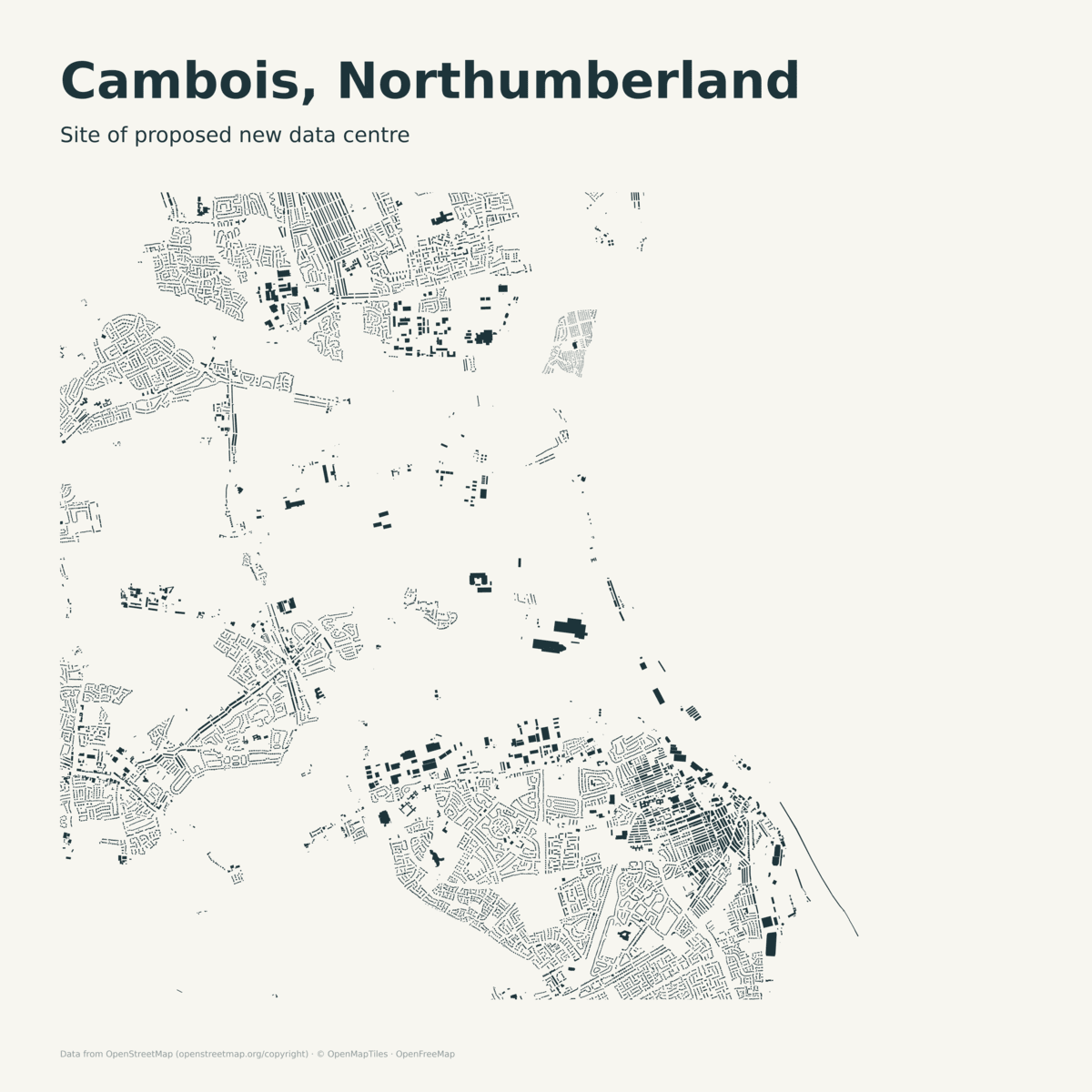
Image created (and paid for) via Tom's Footprints Print Maker.
Enjoyed this? Get new notes by email
A digest of new notes, daily, weekly or monthly. Confirm by email, unsubscribe any time. Prefer a feed reader? Subscribe via RSS.
Around this note
Shares soil with
Suggested by AI from similar content