
Quotations from 'How to Do Nothing'
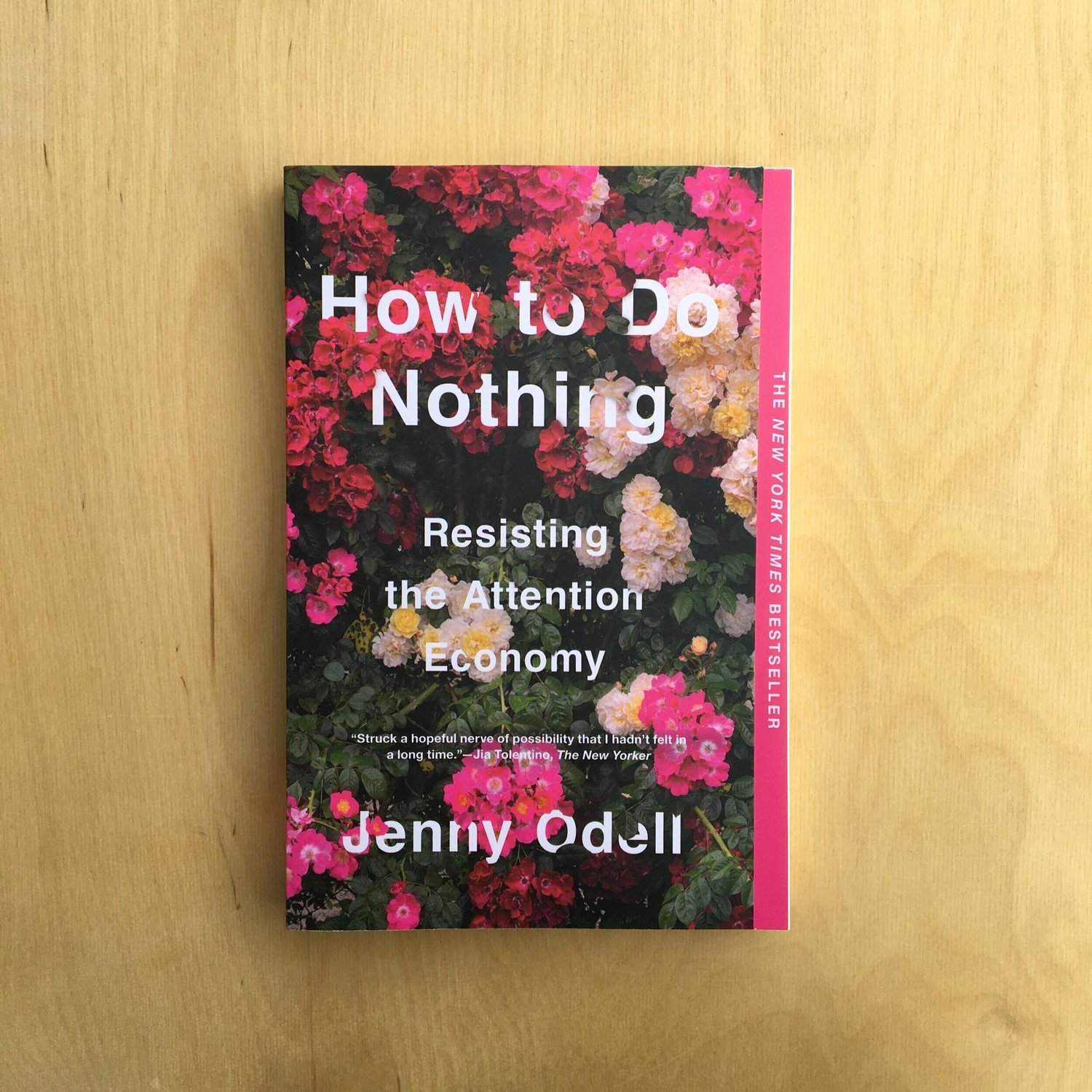
I'm re-reading Jenny Odell's excellent book How to Do Nothing at the moment. Here are some of my highlights (emphasis, where it appears, is mine).
Nothing is harder to do than nothing. In a world where our value is determined by our productivity, many of us find our every last minute captured, optimized, or appropriated as a financial resource by the technologies we use daily. We submit our free time to numerical evaluation, interact with algorithmic versions of each other, and build and maintain personal brands. For some, there may be a kind of engineer’s satisfaction in the streamlining and networking of our entire lived experience. And yet a certain nervous feeling, of being overstimulated and unable to sustain a train of thought, lingers. Though it can be hard to grasp before it disappears behind the screen of distraction, this feeling is in fact urgent. We still recognize that much of what gives one’s life meaning stems from accidents, interruptions, and serendipitous encounters: the “off time” that a mechanistic view of experience seeks to eliminate.
In the early twentieth century, the surrealist painter Giorgio de Chirico foresaw a narrowing horizon for activities as “unproductive” as observation. He wrote: "In the face of the increasingly materialist and pragmatic orientation of our age... it would not be eccentric in the future to contemplate a society in which those who live for the pleasures of the mind will no longer have the right to demand their place in the sun. The writer, the thinker, the dreamer, the poet, the metaphysician, the observer... he who tries to solve a riddle or to pass judgement will become an anachronistic figure, destined to disappear from the face of the earth like the ichthyosaur and the mammoth."
My argument is obviously anticapitalist, especially concerning technologies that encourage a capitalist perception of time, place, self, and community. It is also environmental and historical: I propose that rerouting and deepening one’s attention to place will likely lead to awareness of one’s participation in history and in a more-than-human community. From either a social or ecological perspective, the ultimate goal of “doing nothing” is to wrest our focus from the attention economy and replant it in the public, physical realm.
To resist in place is to make oneself into a shape that cannot so easily be appropriated by a capitalist value system. To do this means refusing the frame of reference: in this case, a frame of reference in which value is determined by productivity, the strength of one’s career, and individual entrepreneurship. It means embracing and trying to inhabit somewhat fuzzier or blobbier ideas: of maintenance as productivity, of the importance of nonverbal communication, and of the mere experience of life as the highest goal. It means recognizing and celebrating a form of the self that changes over time, exceeds algorithmic description, and whose identity doesn’t always stop at the boundary of the individual.
The first half of “doing nothing” is about disengaging from the attention economy; the other half is about reengaging with something else.
Epicurus observed that people in modern society ran in circles, unaware of the source of their unhappiness: Everywhere you can find men who live for empty desires and have no interest in the good life. Stupid fools are those who are never satisfied with what they possess, but only lament what they cannot have.
To stand apart is to take the view of the outsider without leaving, always oriented toward what it is you would have left. It means not fleeing your enemy, but knowing your enemy, which turns out not to be the world — contemptus mundi — but the channels through which you encounter it day to day. It also means giving yourself the critical break that media cycles and narratives will not, allowing yourself to believe in another world while living in this one.
Civil disobedience in the attention economy means withdrawing attention. But doing that by loudly quitting Facebook and then tweeting about it is the same mistake as thinking that the imaginary Pera is a real island that we can reach by boat. A real withdrawal of attention happens first and foremost in the mind. What is needed, then, is not a “once-and-for-all” type of quitting but ongoing training: the ability not just to withdraw attention, but to invest it somewhere else, to enlarge and proliferate it, to improve its acuity.
What’s especially tragic about a mind that imagines itself as something separate, defensible, and capable of “efficiency” is not just that it results in a probably very boring (and bored) person; it’s that it’s based on a complete fallacy about the constitution of the self as something separate from others and from the world. Although I can understand it as the logical outcome of a very human craving for stability and categories, I also see this desire as, ironically, the intersection of many forces inside and outside this imagined “self”: fear of change, capitalist ideas of time and value, and an inability to accept mortality. It’s also about control, since if we recognize that what we experience as the self is completely bound to others, determined not by essential qualities but by relationships, then we must further relinquish the ideas of a controllable identity and of a neutral, apolitical existence (the mythology that attends gentrification). But whether we are the fluid product of our interactions with others is not our choice to make. The only choice is whether to recognize this reality or not.