Pestilence and autoimmune responses
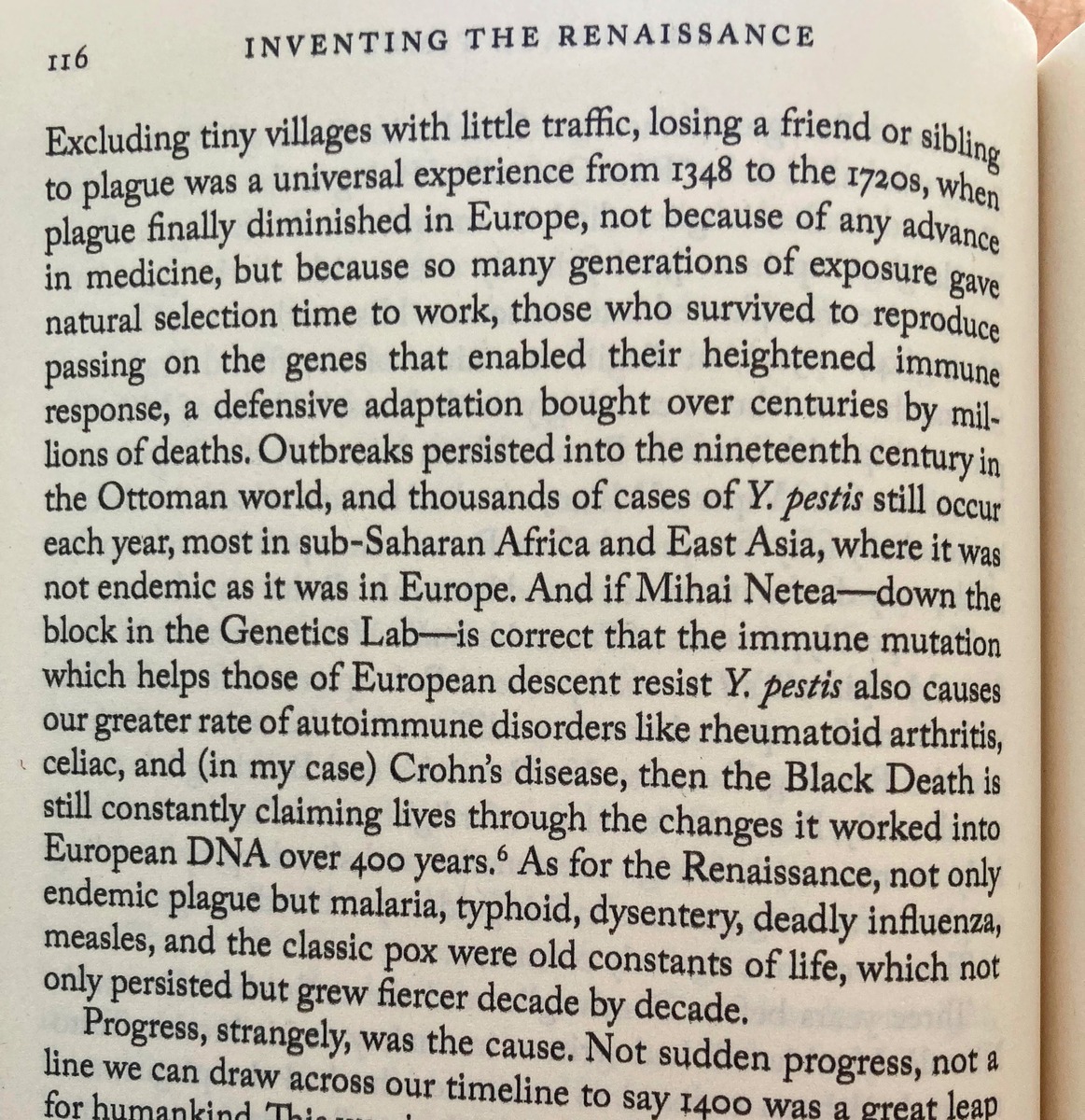 This, from Ada Palmer's excellent Inventing the Renaissance, which she just casually mentions in passing, is pretty mind-blowing:
Excluding tiny villages with little traffic, losing a friend or sibling to plague was a universal experience from 1348 to the 1720s, when plague finally diminished in Europe, not because of any advance in medicine, but because so many generations of exposure gave natural selection time to work, those who survived to reproduce passing on the genes that enabled their heightened immune response, a defensive adaptation bought over centuries by millions of deaths. Outbreaks persisted into the nineteenth century in the Ottoman world, and thousands of cases of Y. pestis still occur each year, most in sub-Saharan Africa and East Asia, where it was not endemic as it was in Europe. And if Mihai Netea—down the block in the Genetics Lab—is correct that the immune mutation which helps those of European descent resist Y. pestis also causes our greater rate of autoimmune disorders like rheumatoid arthritis, celiac, and (in my case) Crohn’s disease, then the Black Death is still constantly claiming lives through the changes it worked into European DNA over 400 years.⁶ As for the Renaissance, not only endemic plague but malaria, typhoid, dysentery, deadly influenza, measles, and the classic pox were old constants of life, which not only persisted but grew fiercer decade by decade.
Having covered both the Black Death and the Great Plague when I was teaching History, I was obviously aware that genetic resistance and natural selection played a part — especially given the numbers we're talking about. But I never thought that modern conditions might be caused by the very thing that protects us from such pestilence.
Enjoyed this? Get new notes by email
A digest of new notes, daily, weekly or monthly. Confirm by email, unsubscribe any time. Prefer a feed reader? Subscribe via RSS.
Around this note
Shares soil with
Suggested by AI from similar content