
European urban birds flee approaching women sooner than approaching men
Well this is odd.
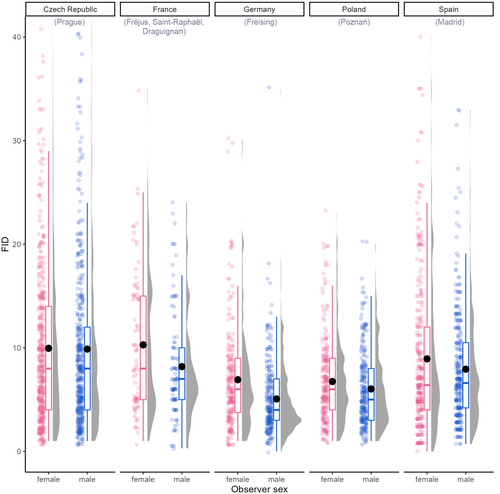
Our study revealed that, after accounting for other variables influencing significant variation in FID [Flight Initiation Distance], birds on average tended to escape from a distance of about 1 m longer when approached by women compared to men. Birds were less tolerant of women than of men, and this result was geographically consistent. These differences were still present when exploring FID versus observer's sex separately for bird males and females in the cities of each country. On average, birds escaped 1 m (11% of their mean escape distance) earlier when approached by women than by men.
While we found a consistent observer sex-specific pattern, the mechanisms or causes that underlie this pattern are unknown. There are several factors that can potentially explain the observed differences in the birds' reactions to people. Differences in the physical appearance of observers (e.g. hair length, body size, height, etc.), movement patterns (e.g. hip movement, overall walking gait) or different clothing could be candidate factors. But we can reject these because, in our study, they were either controlled or their differences were non-significant. We can reject gross morphology since the woman and man working at a given site were similarly tall and hid their hair if it was longer than their partner's. Additionally, bird FIDs were not related to the height of approaching observers in a recent study (Van Dongen et al., 2015). However, despite our attempts to minimize obvious differences in appearance between male and female observers, birds still may be able to detect subtle external morphological differences in hair length/style, waist-hip ratio or gait, as well as odour, which would necessitate specific field experimental designs.
Considering that men were traditionally considered hunters and women as gatherers in human societies (Kelly, 2013) and, as demonstrated by Carrete et al. (2016), a long exposure to different threats should promote adaptive heritable behaviour in birds, we expected that birds would perceive men as more threatening than women. However, our results challenge the potential long-lasting heritability of escape responses to humans concerning how threatening humans are to birds.
Source: British Ecological Society